
Loud AC Unit? Here’s How to Diagnose the Noise Fast
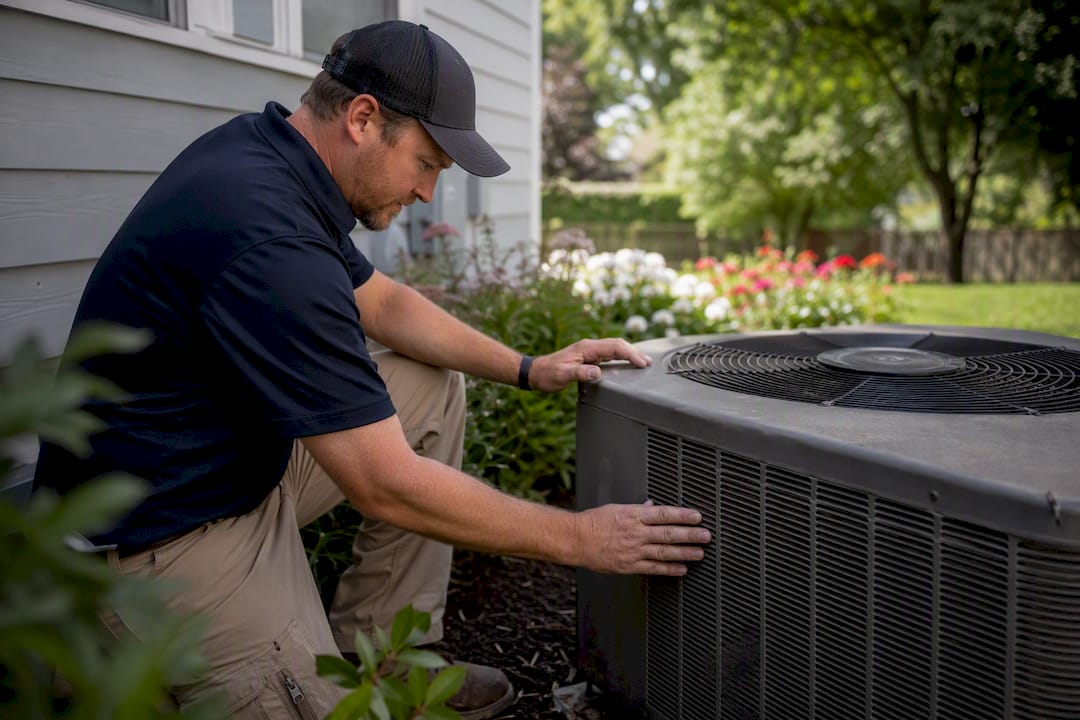
A loud AC unit almost always points to one of three problems: something mechanical is failing, something electrical has gone wrong, or airflow is restricted somewhere in the system. The sound itself tells you which one you’re dealing with, and that’s the fastest path to fixing it correctly instead of guessing.
Start here. Grinding, hissing, a burning smell, sparks, or an outdoor fan that won’t spin while the unit hums are all reasons to shut the system off right now and call a technician. Everything else usually gives you a little more room to check things yourself first.
- Record 15 to 20 seconds of the sound on your phone.
- If it’s grinding, hissing, or smells electrical, turn the thermostat to OFF and cut power at the outdoor disconnect.
- Walk outside and clear leaves, sticks, or grass clippings away from the condenser cabinet.
- Pull the indoor air filter and check whether it’s clogged.
Don’t open the electrical access panel, and never try to spin a stuck outdoor fan by hand. A stalled fan with a humming compressor can mean the motor is seizing, and that’s a job for someone with a meter and gloves, not a screwdriver.
Pro Tip: When you record the noise, say out loud whether it happens at startup, during the run cycle, or at shutoff. That single detail cuts a technician’s diagnostic time way down, because a startup click and a mid-cycle grind point to completely different parts.
Key Takeaways
A loud AC unit almost always signals a mechanical, electrical, or airflow problem, and matching the specific sound to its likely cause determines whether it’s a safe DIY fix or an urgent call to a technician.
| Point | Details |
|---|---|
| Match sound to location | Indoor noises trace to the blower and ducts; outdoor noises trace to the compressor and fan. |
| Grinding means stop now | Metal-on-metal grinding signals bearing failure and should never keep running. |
| Four sounds warn early | Hard-starting, grinding, squealing, and banging often precede compressor failure by weeks to months. |
| Filters and debris are free fixes | A clogged filter or debris-packed condenser causes a surprising share of “urgent-sounding” noise. |
| Call Ricotta for diagnosis | Ricotta Heating & Air offers a written estimate and transparent repair-vs-replace guidance for noisy systems in St. Louis and Jefferson County. |
Table of Contents
- Does the Noise Come From Indoors or Outdoors?
- What Does Each AC Noise Actually Mean?
- What Can You Safely Check Yourself Right Now?
- Which DIY Fixes Actually Reduce AC Noise?
- When Should You Shut the AC Off and Call a Pro?
- How Much Do Common AC Repairs Cost?
- How Do You Keep Your AC Running Quietly?
- If You’d Rather Not DIY, Here’s How Ricotta Helps
- Sources
Does the Noise Come From Indoors or Outdoors?
Where the sound originates narrows the list of suspects fast. Indoor noises trace back to the blower assembly, air handler, ductwork, or refrigerant lines running through your walls. Outdoor noises come from the compressor, condenser fan motor, mounting pads, or the cabinet itself rattling in the wind.
Compressors and outdoor condensers typically run louder than indoor components simply because of where they sit and how exposed they are, according to Daikin’s guidance on AC noise ratings. That’s useful context: if the outdoor unit sounds like a lawnmower idling, that’s often within normal range for an aging system, not automatically a red flag.
- Gurgling or hissing near a supply vent or indoor line set usually means refrigerant flow noise or air in the lines.
- Grinding or sharp banging is far more likely mechanical, and it’s almost always outdoors.
- A rattle that changes pitch as you walk room to room usually means loose ductwork, not the unit itself.
Pro Tip: Stand next to the indoor air handler with the system running, then walk outside next to the condenser. Whichever spot makes the sound noticeably louder is your source. It sounds obvious, but most homeowners skip this step and start guessing.
What Does Each AC Noise Actually Mean?
Every sound your AC makes carries information. Some are background noise you should ignore. Others are your system telling you a part is about to fail. Here’s how to read them.
Normal operation includes a steady hum from the fan and compressor, plus a single click when the system starts or stops, according to Maytag’s guide to normal and abnormal HVAC noises. Anything louder than that baseline, or any new sound that wasn’t there last week, deserves attention.
Buzzing. A steady electrical buzz with the outdoor fan still spinning is often loose hardware or debris hitting the cabinet, which you can check yourself. But a hard buzz where the fan has stopped moving usually points to a failed capacitor, seized motor, or bad contactor, and that’s electrical work for a technician.
Grinding. This is one of the more serious sounds you’ll hear from an AC. Metal-on-metal grinding almost always means bearing failure or mechanical parts rubbing where they shouldn’t, according to Hitachi’s breakdown of common AC noises. Grinding is a shut-it-off-now noise, not a wait-and-see one.
Rattling. Loose screws, a panel that’s worked itself free, or debris rattling inside the cabinet. This is usually the least urgent noise on the list and often fixable with a screwdriver.
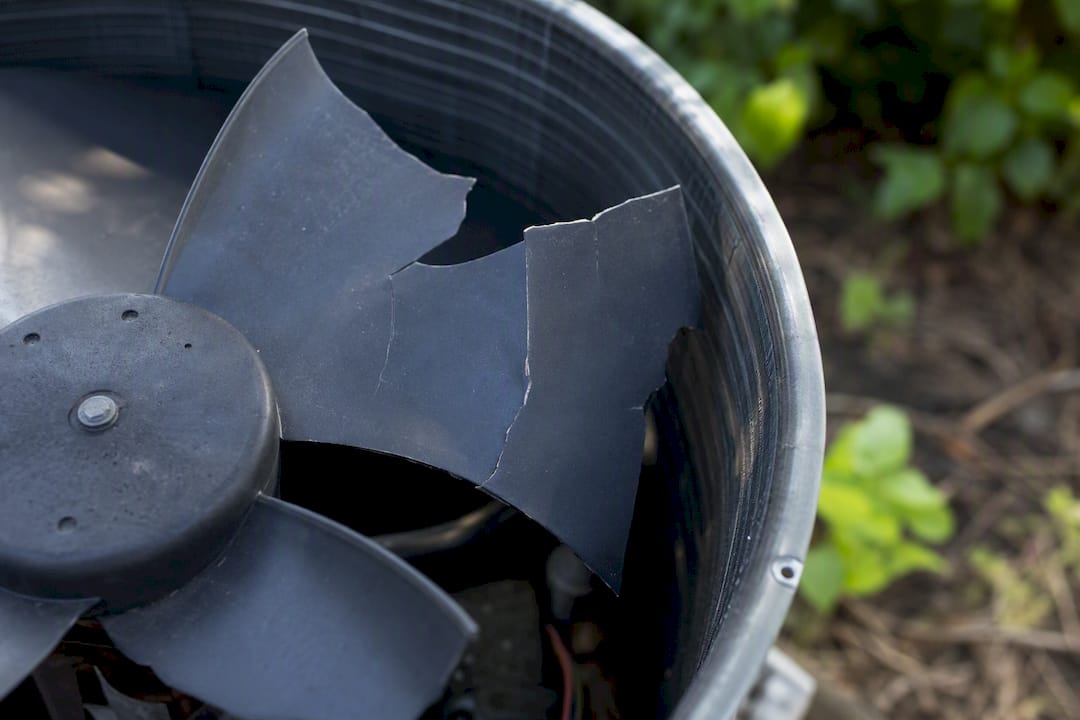
Banging. A loud, irregular bang can mean a broken or unbalanced fan blade, a loose part striking the housing during rotation, or in more serious cases, a compressor part breaking loose internally. Banging that’s rhythmic and matches the fan’s rotation speed is more likely a blade issue; random, sharp bangs deserve a technician’s eyes.
Hissing. Low hissing during startup is often normal refrigerant movement, but constant hissing paired with weaker cooling than usual can mean a refrigerant leak. That combination is worth a same-week call, not an emergency shutdown, unless cooling has dropped off sharply.
Clicking. One click at startup and one at shutoff is completely normal. Repeated, rapid clicking that doesn’t lead to the system actually starting usually points to a failing relay or a control board issue.
Whistling. A high-pitched whistle almost always means airflow is squeezing through somewhere too small, like an undersized return, a nearly-closed damper, or a filter so clogged that air is forcing its way around the edges instead of through it.
Gurgling. Common in refrigerant lines and often normal on startup or shutdown as pressure equalizes. Persistent gurgling during the run cycle is a different story and often means air has gotten into the line set.
Short-cycling. If the system is turning on and off every few minutes, that’s not really a “sound” so much as a pattern, but it often comes with extra clicking and humming. It can point to an oversized system, a dirty filter choking airflow, or a failing thermostat sensor.
| Sound | Likely Cause | Severity | Next Step |
|---|---|---|---|
| Buzzing (fan spinning) | Loose panel, debris, minor electrical hum | Low | Check and tighten hardware |
| Buzzing (fan stopped) | Failed capacitor, seized motor, bad contactor | Urgent | Power off, call a technician |
| Grinding | Bearing failure, mechanical contact | Urgent | Shut off immediately |
| Rattling | Loose screws, debris in cabinet | Low | DIY check and tighten |
| Banging | Broken fan blade, loose internal part | Moderate to urgent | Power off, inspect or call pro |
| Hissing | Refrigerant flow (normal) or leak (abnormal) | Moderate | Watch cooling performance |
| Clicking (repeated) | Failing relay or control board | Moderate | Call a technician |
| Whistling | Airflow restriction, clogged filter | Low | Replace filter, check vents |
| Gurgling | Air in line set or normal pressure change | Low to moderate | Monitor, call if persistent |
Four sounds in particular, hard-starting, grinding, a high-pitched squeal, and intermittent banging, tend to show up weeks to months before a compressor fails outright, often alongside rising electric bills or longer run cycles, according to Building Talks’ research on compressor warning signs. If you’re hearing more than one of these together, don’t wait for the fourth.
What Can You Safely Check Yourself Right Now?
Before you call anyone, a few minutes of observation gives a technician a huge head start and might solve the problem outright.
- Record the noise and note whether it happens at startup, mid-cycle, or shutdown.
- Stand near the indoor unit, then the outdoor unit, to confirm which one is louder.
- Look at the outdoor condenser fan through the top grille. Is it spinning freely, wobbling, or stopped?
- Clear leaves, mulch, or grass clippings from around the outdoor cabinet.
- Pull the return air filter and hold it up to a light. If you can’t see light through it, replace it. A clogged filter forces your system to work like it’s breathing through a pillow, and that strain shows up as whistling or a labored hum.
- Check any exterior panel screws you can reach without tools and snap them back down if loose.
A stopped outdoor fan paired with a humming compressor means the compressor is still trying to run without cooling itself. Letting that continue can overheat the compressor within minutes, so this is a shut-it-down-now situation, not a wait-and-see one.
Note the date it started, whether a storm or heavy pollen event preceded it, and whether your cooling has changed. That timeline matters more than you’d think.
Which DIY Fixes Actually Reduce AC Noise?
Several noise causes respond well to basic homeowner maintenance, no HVAC license required.
- Turn the thermostat off before doing anything hands-on.
- If you’re comfortable, cut power at the outdoor disconnect box for extra safety.
- Clear debris, leaves, and overgrown plants from at least a two-foot radius around the condenser.
- Hose the condenser fins gently from the inside out, never with a pressure washer, which can bend the fins.
- Replace or clean the return filter.
- Tighten any loose exterior panel screws and reset rattling vent registers indoors.
Tools you’ll need: a screwdriver, a garden hose with a spray nozzle, a shop vacuum for indoor grilles, and a replacement filter matched to your system’s size.
Never attempt these fixes, even if you’re handy:
- Opening the electrical disconnect box or working near capacitors.
- Replacing a capacitor yourself, since it holds a stored electrical charge even after power is cut.
- Adding or “topping off” refrigerant, which is federally regulated and requires certification.
Pro Tip: When hosing the condenser, spray from the inside of the fin assembly outward. Spraying from outside in packs dirt deeper between the fins instead of flushing it out.
When Should You Shut the AC Off and Call a Pro?
Some noises aren’t a maintenance item. They’re a stop-using-it-today signal.
- Grinding or metal-on-metal sounds: turn the thermostat off and schedule service immediately.
- Persistent loud banging: power down at the disconnect and don’t restart until inspected.
- Hissing combined with weak cooling: likely a refrigerant leak, cut the system off and call for service this week.
- Burning smell or visible smoke: shut off power at the breaker, not just the thermostat, and call for emergency service.
- Sparks or a tripped breaker: leave the breaker off and don’t attempt to reset it yourself.
- Outdoor fan not spinning while the compressor hums: shut off immediately to prevent compressor overheating.
Pro Tip: Before the technician arrives, have three things ready: the sound recording, your system’s approximate age, and whether you’ve had any recent repairs. That trio usually cuts diagnostic time in half.
How Much Do Common AC Repairs Cost?
Repair costs vary by part, but a few benchmarks help you set expectations before a technician even arrives.
- Capacitor replacement: a relatively quick, low-cost fix, often completed same-day.
- Contactor replacement: similarly quick and inexpensive, usually resolved in one visit.
- Fan motor replacement: a moderate repair, typically completed within a day once the part is on hand.
- Fan blade replacement: inexpensive and fast if the blade is available in stock.
- Compressor repair or replacement: the most expensive repair on this list by a wide margin, since compressors are the most complex and costly component in the system.
- Vibration pads and panel hardware: minor cost, often bundled into a standard service call.
| System Age | Repair-vs-Replace Guidance |
|---|---|
| Under 10 to 12 years | Repair is usually the better value, especially for capacitors, contactors, or fan motors |
| 10 to 12 years or older | Weigh repair cost against remaining lifespan, especially for compressor failures |
| Any age, under warranty | Check warranty coverage before paying out of pocket |
A good rule of thumb: if a single repair estimate approaches half the cost of a full replacement, and your system is already past the 10 to 12 year mark, replacement usually makes more financial sense than a second repair down the road.
How Do You Keep Your AC Running Quietly?
A little upkeep prevents most of the loud, urgent problems above from ever happening.
- Check or replace filters monthly during peak cooling season, quarterly otherwise.
- Schedule a professional tune-up once a year, ideally before the first hot stretch of the year.
- Clear leaves and debris around the outdoor unit every season, not just in fall.
- Have coils cleaned when airflow noticeably drops or the system runs longer than usual.
- Replace cracked or compressed rubber vibration pads under the outdoor unit; they’re inexpensive and cut down on rattling.
- Ask about a compressor sound blanket if your outdoor unit sits close to a bedroom window.
Cleaning condenser fins and swapping out worn vibration feet are some of the cheapest noise fixes available, and they often head off bigger mechanical wear before it starts.
Pro Tip: If your outdoor unit sits on cracked or sinking concrete, the noise you’re hearing might be vibration transmitting through the pad itself, not the unit at all. A new isolation pad can be a surprisingly cheap fix for a problem that sounds expensive.
How Does a Ricotta Technician Diagnose a Noisy AC?
A methodical check beats guesswork every time. Here’s the sequence a trained technician typically runs through on a noise complaint:
- Confirm whether the noise happens at startup, during the run cycle, or at shutoff.
- Inspect the outdoor cabinet, fan blade, and motor mount for damage or looseness.
- Test the capacitor and contactor for proper function.
- Check compressor start behavior under load.
- Inspect the indoor blower wheel and duct mounting for looseness or debris.
A noise that only happens on startup almost always points to a different part than a noise that runs the whole cycle. Technicians treat those as two separate diagnostic paths from the first minute of the visit.
Why Catching a Loud AC Early Actually Saves You Money
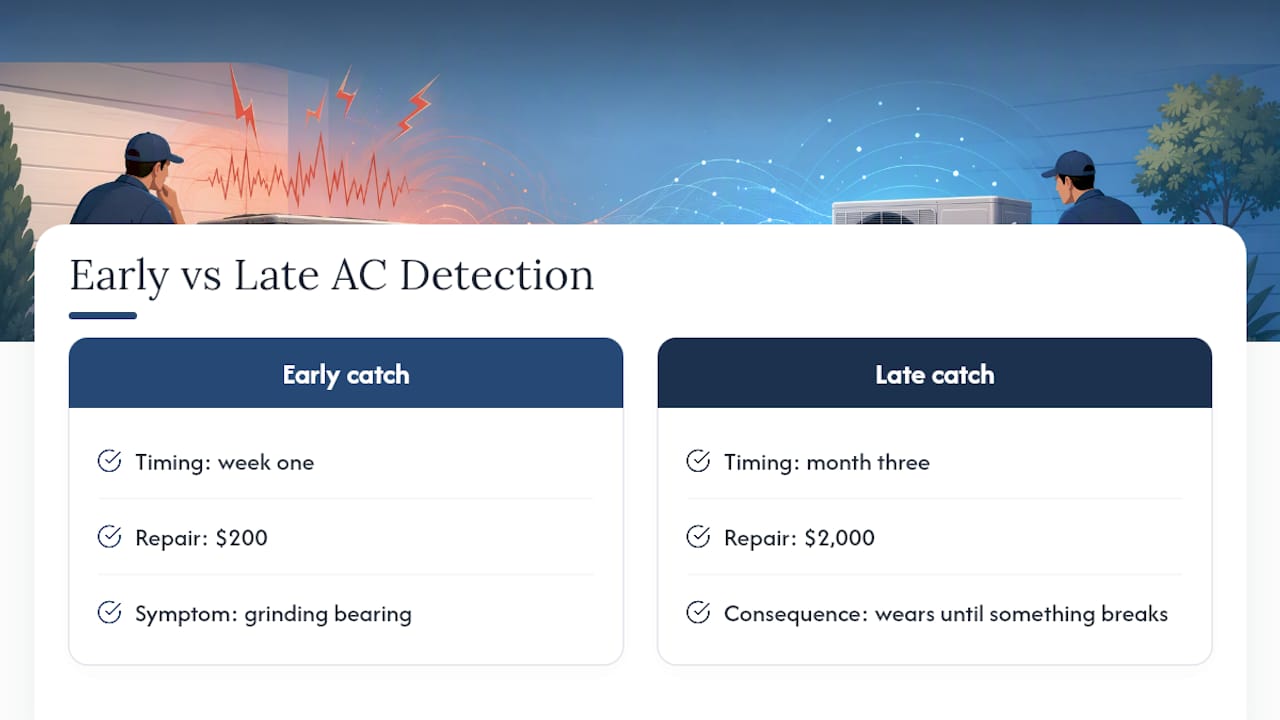
The most common mistake homeowners make isn’t ignoring a loud AC unit outright, it’s assuming a “weird noise” will just go away on its own. It rarely does. A grinding bearing doesn’t heal; it wears until something breaks. Catching that sound in week one instead of month three is usually the difference between a $200 repair and a $2,000 one.
Ricotta Heating & Air has spent decades working on systems across St. Louis and Jefferson County, and that local, family-owned footprint means we’ve heard nearly every noise variation a residential system can make.
If You’d Rather Not DIY, Here’s How Ricotta Helps
If the checks above raise more questions than answers, or you’ve already landed on grinding, hissing, or a stalled fan, it’s worth having someone look at it before the small problem becomes a compressor replacement. Ricotta Heating & Air runs a diagnostic visit, gives you a written estimate before any work starts, and tells you plainly whether repair or replacement makes more financial sense for your system’s age.

Every service call includes a safety check of the electrical components, an on-site diagnosis you can actually understand, transparent pricing with no upsell pressure, and a clear timeline for the fix. If your outdoor unit is the culprit, our AC repair services cover everything from a quick capacitor swap to a full compressor evaluation. Homeowners who want to avoid a repeat visit next summer can also ask about our HVAC maintenance plans, which catch worn pads and loose mounts before they turn into loud problems. Book a diagnostic visit and get a straight answer on what’s causing the noise, and what it’ll actually take to fix it.
Sources
- AC compressor warning sounds before failure | Building Talks
- Normal and abnormal HVAC noises | Maytag HVAC
- AC noises: why does my air conditioner make weird sounds? | Hitachi Air Conditioning
These come from manufacturers and industry diagnostic guides, chosen because they define the normal-versus-abnormal baseline this article relies on throughout.