
AC Not Cooling? Quick Checks Every Homeowner Should Try

Your AC is running, but the air coming out of the vents is warm. Before you panic, know this: most cases of an AC not cooling come down to one of a handful of fixable issues, and several of them take less than 15 minutes to check yourself. The most common culprits are a wrong thermostat setting, a clogged air filter, a blocked outdoor condenser, or a frozen evaporator coil. Low refrigerant and electrical component failures are less common but require a professional.
Do this right now: Check your thermostat. Make sure it’s set to “Cool” and the fan is set to “Auto,” not “On.” A fan set to “On” circulates room-temperature air even when the compressor is off, which can feel exactly like a broken AC.
SAFETY FIRST: If you see ice on the copper lines or indoor unit, water pooling near the air handler, or you smell something burning near any part of the system, shut the AC off at the thermostat immediately. Do not restart it until a technician has inspected it.
Table of Contents
- Why is my AC not cooling? The most common causes
- Safe DIY checks you can do right now
- What a technician checks and what repairs typically cost
- How regular maintenance prevents cooling problems
- When should you call a professional?
- Key Takeaways
- What 50 years of St. Louis summers have taught us about AC failures
- Ricottaheatingandair can diagnose and fix it the same day
- Useful sources for further reading
Why is my AC not cooling? The most common causes
Most cooling problems fall into one of eight categories. Here’s how to match what you’re seeing to the likely cause, and whether it’s safe to address yourself.
-
Thermostat set to “Fan On” instead of “Auto.” When the fan runs continuously, it pushes uncooled air through your vents whenever the compressor is idle. Set the thermostat to “Cool” mode and “Auto” fan, then wait 15 minutes to see if cold air returns. This is the single most overlooked cause of an AC unit blowing warm air.
-
Clogged or dirty air filter. A dirty air filter restricts airflow, forces the system to work harder, and can cause the evaporator coil to freeze. Think of it like trying to breathe through a pillow. Consumer Reports notes that HVAC filters typically last several months, but if you have pets or run the system constantly, you’ll need to swap them more often.
-
Blocked supply or return vents. Furniture pushed against a vent, a closed register, or a rug covering a return grille can quietly strangle your system’s airflow. Walk through every room and confirm vents are open and unobstructed.
-
Dirty or blocked outdoor condenser. The outdoor unit sheds the heat your system pulls from inside your home. If leaves, grass clippings, or overgrown shrubs are packed against it, heat can’t escape. Consumer Reports recommends adequate clearance around the unit and above it to ensure proper airflow.
-
Frozen evaporator coil. Ice on the indoor coil or refrigerant lines is a sign the system can’t move heat properly. Ice buildup on the evaporator coil, hissing or bubbling sounds, or warm air only after long run-times all point to issues beyond basic DIY maintenance. Shut the system off and let it thaw before doing anything else.
-
Low refrigerant or a refrigerant leak. Refrigerant doesn’t get “used up” like gasoline. Low refrigerant always means a leak that must be found, repaired, and then properly recharged by a certified technician. Signs include a hissing or bubbling sound near the lines and oily residue around fittings.
-
Failed capacitor or condenser fan motor. A failing capacitor or fan motor often causes the compressor to run while the outdoor fan sits still. Without the fan spinning, the unit can’t release heat, and warm air is the result. You’ll usually hear a humming from the outdoor unit with no fan movement.
-
Aging system or compressor failure. If your system is 15 or more years old and none of the above checks pan out, the compressor itself may be failing. An undersized system for your home’s square footage will also struggle on the hottest days, even when everything is technically working.
Safe DIY checks you can do right now
Work through these steps in order. Most take only a few minutes, and together they cover the majority of common AC problems.
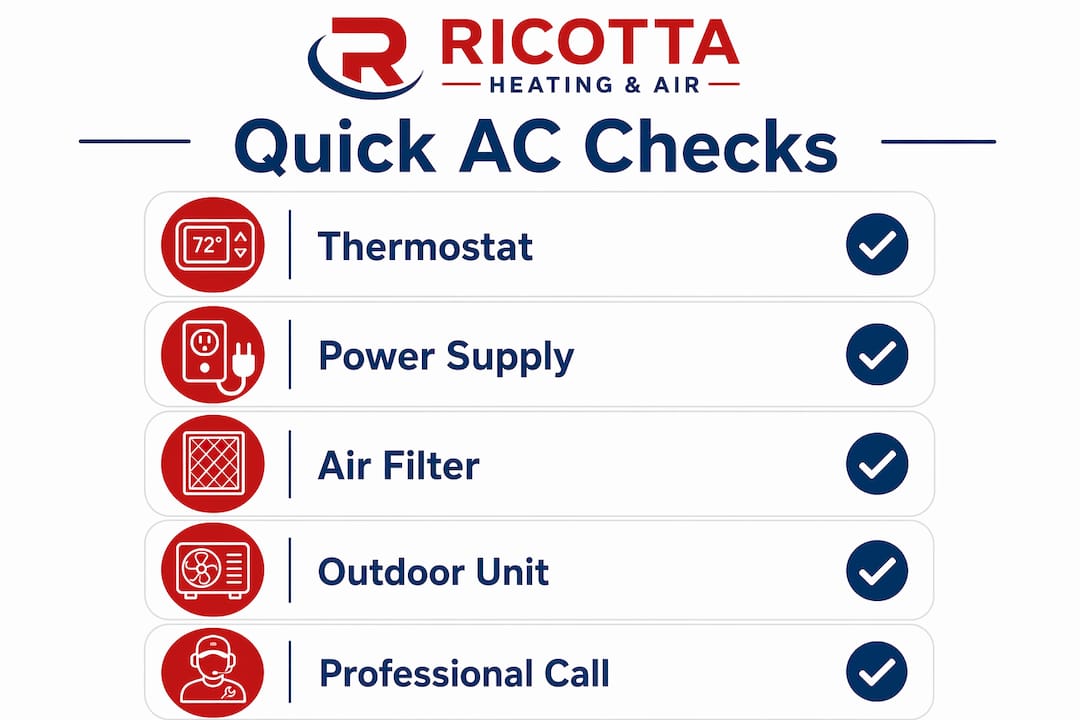
Step 1: Confirm thermostat settings. Set mode to “Cool” and fan to “Auto.” Drop the set temperature at least 5°F below the current room temperature. If your thermostat display is dim, replace the batteries.
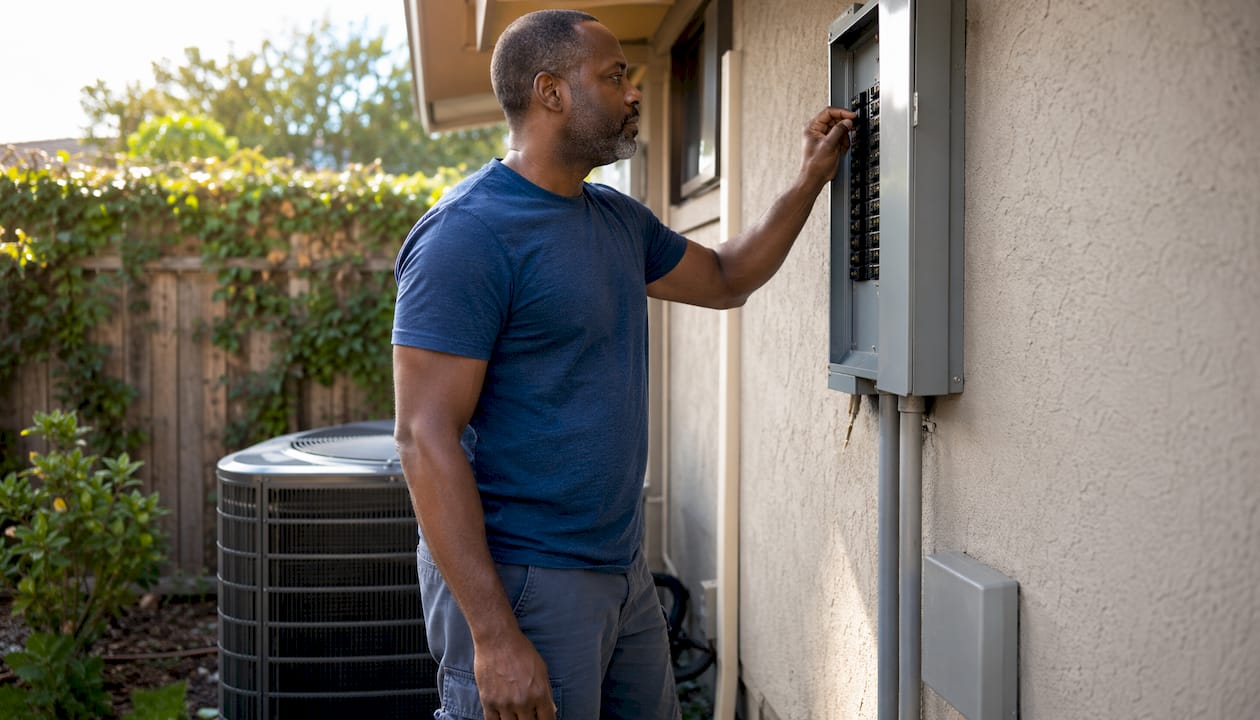
Step 2: Check the circuit breaker and outdoor disconnect. Your system has two power points to verify: the main breaker panel inside and the outdoor disconnect box mounted near the condenser. A tripped breaker will cut power to the compressor while the indoor fan keeps running. Reset any tripped breaker once, and if it trips again, stop and call a technician.
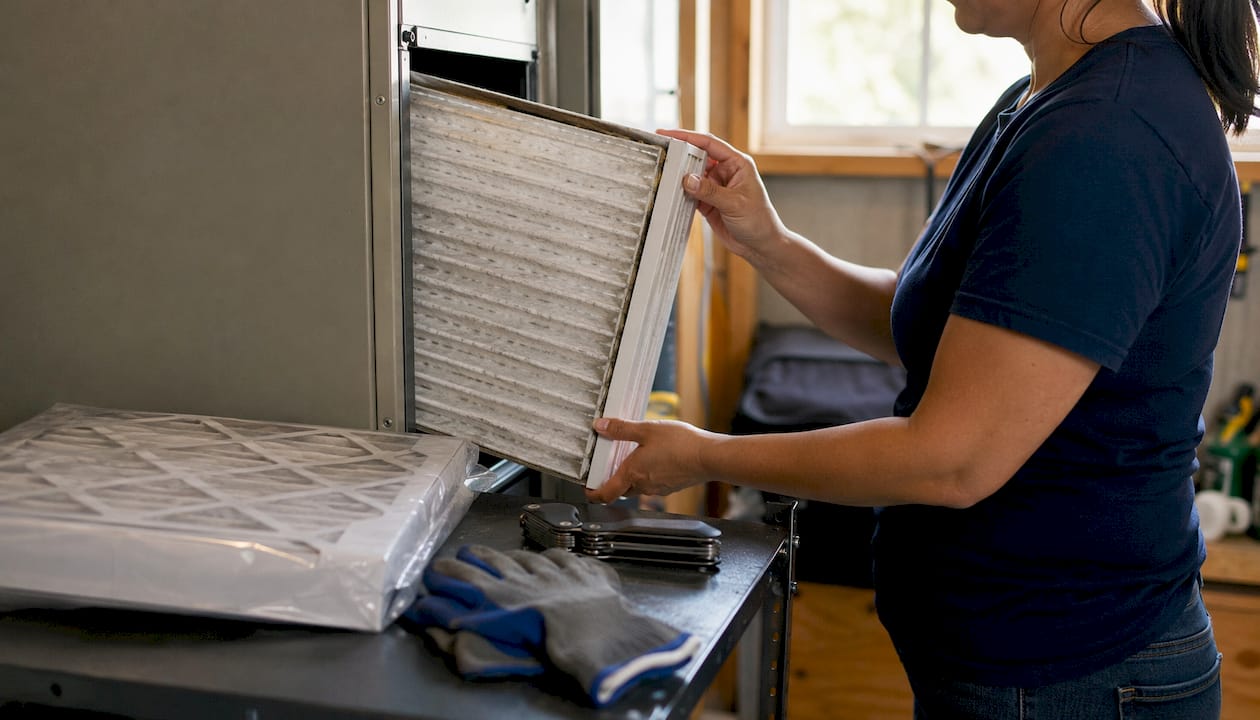
Step 3: Inspect and replace the air filter. Pull the filter out and hold it up to a light. If you can’t see light through it, replace it now. A fresh filter takes about two minutes to install and can restore cooling on its own.
Step 4: Check the outdoor unit. Walk outside while the system is calling for cool. The outdoor fan should be spinning. Clear any leaves, debris, or vegetation within 2 feet of the unit. You can rinse the condenser fins gently with a garden hose from the outside in, but do not use a pressure washer.
Step 5: Look for ice. Check the copper refrigerant lines running into your indoor air handler. If you see frost or ice, shut the system off at the thermostat and set the fan to “On” (not “Cool”) to circulate air and speed up the thaw. Allow at least two hours.
IMPORTANT: Never chip at ice on the coil. A screwdriver or any sharp tool can puncture the coil, causing a refrigerant leak and potentially destroying the compressor. Let it thaw on its own.
Pro Tip: If your home feels warm immediately when you turn the system on, the problem is usually airflow (filter, vents, or fan setting). If the air starts cool but turns warm after 20–30 minutes of run-time, that pattern points more strongly toward low refrigerant or a coil freezing up.
What NOT to do:
- Do not add refrigerant yourself. It requires EPA Section 608 certification and proper pressure measurement.
- Do not open the electrical panel or the outdoor unit’s wiring compartment unless you are a licensed electrician.
- Do not restart a system that smells like burning or has been tripping breakers repeatedly.
What a technician checks and what repairs typically cost
When DIY checks don’t restore cooling, a professional diagnostic visit gives you measured data, not guesswork. Here’s the sequence a qualified technician follows:
- Visual inspection. Check for ice, water damage, obvious wiring issues, and signs of refrigerant oil around fittings.
- Power and controls verification. Confirm voltage at the disconnect, test the contactor, and check thermostat signals.
- Temperature and airflow measurement. Measure supply and return air temperatures (the difference, called the “delta T,” should typically be 15–20°F) and check static pressure across the filter and coil.
- Refrigerant pressure testing. Measure suction and discharge pressures, then calculate superheat and subcooling to determine whether the charge is correct and whether a metering device is stuck. If both the indoor and outdoor units are running but supply air is warm, low refrigerant or a stuck expansion device is a likely cause.
- Electrical component testing. Test capacitors with a capacitance meter, check the contactor for pitting or burning, and verify motor amp draws.
- Leak detection. Use an electronic leak detector or UV dye to locate refrigerant leaks before recharging.
IMPORTANT: Under EPA regulations, only technicians with Section 608 certification may purchase and handle refrigerants. Adding refrigerant without finding and repairing the leak first is both a regulatory violation and a temporary fix at best.
Accurate diagnosis prevents unnecessary parts swaps. A technician who measures before replacing saves you money and repeat service calls.
| Repair Type | Typical Cost Range | Typical Time on Site |
|---|---|---|
| Capacitor replacement | $150 | 1 hour |
| Condenser fan motor replacement | $300 | 1–2 hours |
| Refrigerant leak repair + recharge | $400 | 2–4 hours |
| Evaporator or condenser coil cleaning | $400 | 1–2 hours |
| Condensate drain clearing | $75 | 30 minutes |
| Compressor replacement | $1,200 | 3–6 hours |
Ranges reflect typical residential repair costs, but final pricing depends on system size, refrigerant type, and parts availability.
How regular maintenance prevents cooling problems
The repairs in the table above share a common thread: most of them are either prevented or caught early by annual maintenance. Ignoring poor cooling accelerates failures — a dirty filter freezes the coil, a frozen coil forces the compressor to work harder, and a stressed compressor fails years ahead of schedule.
The math is straightforward: a modest annual tune-up is a fraction of the cost of refrigerant repairs or compressor replacements.
A well-maintained system also runs more efficiently, which shows up on your utility bill every month of the cooling season.
| Season / Timing | Maintenance Task | Who Does It |
|---|---|---|
| Spring (before first use) | Condenser cleaning, coil inspection, electrical check | Technician |
| Pre-summer (May–June) | Full tune-up: refrigerant check, capacitor test, drain flush | Technician |
| Monthly (June–September) | Air filter inspection and replacement if dirty | Homeowner |
| Fall (after last use) | Condensate drain clearing, cover outdoor unit if applicable | Homeowner / Technician |
| Annually | Refrigerant leak scan, blower motor check, thermostat calibration | Technician |
A service agreement with Ricottaheatingandair covers the technician tasks in this schedule and typically costs less per year than a single emergency repair call. For homeowners in St. Louis and Jefferson County, where summer temperatures routinely push into the 90s, that kind of proactive coverage is worth having before the heat arrives, not after.
When should you call a professional?
Some symptoms are safe to troubleshoot yourself. Others mean you should stop, shut the system off, and call a technician the same day.
Call immediately if you notice any of these:
- Ice on the evaporator coil or refrigerant lines that returns after thawing.
- Water pooling near the air handler or a tripped condensate safety float.
- A burning or electrical smell from any part of the system.
- The outdoor fan is not spinning while the compressor is running and humming.
- Loud grinding, screeching, or sustained buzzing from the outdoor unit.
- The circuit breaker for the AC trips more than once.
For homeowners dealing with an outdoor unit that won’t run, the outdoor fan and capacitor are the first things a technician will check.
Before the technician arrives, do this:
- Write down when the problem started and what you noticed first (warm air immediately vs. after run-time, any sounds, any error codes).
- Take a photo of the outdoor unit and the indoor air handler, including any visible ice or water.
- If you have a smart thermostat, check the app for diagnostic codes or alerts and have them ready to share. Those codes can cut diagnostic time significantly.
- Note the system’s age, brand, and model number (usually on a label on the outdoor unit).
A standard service visit includes a safety check, measured diagnostics (pressures, temperatures, electrical readings), and a written estimate covering parts, labor, and any warranty terms. When reviewing a quote, look for actual measured values in the diagnosis notes, a clear parts-and-labor breakdown, and a stated warranty on the repair. A quote that says only “low refrigerant, recharge needed” without a leak repair line item is incomplete.
Key Takeaways
Most AC cooling failures trace back to airflow or heat-exchange problems that either a quick homeowner check or a single professional diagnostic visit can resolve before they cascade into compressor damage.
| Point | Details |
|---|---|
| Check the thermostat first | Set mode to “Cool” and fan to “Auto” before assuming a mechanical failure. |
| Replace a dirty filter immediately | A clogged filter is the leading cause of poor cooling and can freeze the evaporator coil. |
| Never add refrigerant yourself | Low refrigerant always means a leak; only an EPA-certified technician can repair and recharge safely. |
| Stop and call for these symptoms | Ice that returns, burning smells, outdoor fan not spinning, or repeated breaker trips all require same-day service. |
| Ricottaheatingandair for local diagnostics | For St. Louis and Jefferson County homeowners, Ricottaheatingandair provides honest diagnostics and transparent repair estimates backed by 150+ five-star reviews. |
What 50 years of St. Louis summers have taught us about AC failures
Most homeowners who call us in July have been living with a warning sign for weeks. The system was a little slower to cool. The filter hadn’t been changed since last fall. The outdoor unit had a season’s worth of cottonwood packed against the fins. None of those things feel urgent until it’s 95°F and the house won’t drop below 82°F.
Here’s the honest truth about air conditioner troubleshooting: the DIY checks in this guide genuinely work for a large share of calls we receive. A wrong fan setting or a clogged filter accounts for more “broken AC” calls than most homeowners expect. But the cases that concern me are the ones where a homeowner has been running a system with a slow refrigerant leak for a full season, because by the time the compressor finally gives out, a $400 repair has turned into a $2,500 one.
The pattern I’d want every homeowner to remember is this: warm air that shows up immediately usually means airflow. Warm air that creeps in after the system has been running for 20 minutes or more usually means refrigerant or a coil problem. That distinction tells you whether to change a filter or pick up the phone.
Ricottaheatingandair can diagnose and fix it the same day
When the quick checks don’t bring the cold air back, you need a technician who will measure first and replace only what’s actually broken.

Ricottaheatingandair is a family-owned HVAC company serving St. Louis and Jefferson County homeowners with over 50 years of local experience and 150+ five-star Google reviews. There’s no upselling here: you get an honest diagnostic, a clear written estimate, and a repair backed by a warranty. Services include refrigerant leak repair and recharge, capacitor and fan motor replacement, coil cleaning, condensate drain service, and annual maintenance plans that keep these problems from showing up in the first place. For urgent situations, emergency repair options are available.
If your home isn’t cooling and you’ve worked through the checks above, the next step is a professional diagnostic visit. Schedule your AC repair with Ricottaheatingandair today and get your home comfortable again before the next heat wave hits.
Useful sources for further reading
These authoritative resources back the guidance in this article and are worth bookmarking for reference. When you call a technician, sharing any error codes, measured temperatures, or observations from these checklists will speed up the diagnostic.
- Consumer Reports: 8 Air Conditioner Problems and How to Fix Them — Expert-sourced checklist covering the most common AC problems, including filter maintenance and thermostat settings. Useful for window and central AC systems alike.
- Carrier: Troubleshoot an AC Not Working — Manufacturer-backed step-by-step guide covering power checks, filter inspection, and when to call a pro.
- Trane: Air Conditioner Troubleshooting — Covers filter-related failures and the cascading damage that poor maintenance can cause.
- Bryant: Why Is My AC Not Working? — Explains capacitor and fan motor failures in plain language, with guidance on what to check before calling for service.
- InspectApedia: AC Blows Warm Air — Technical reference covering refrigerant metering devices, pressure diagnostics, and the two power disconnects homeowners should check.
- EPA: Section 608 Refrigerant Regulations — The primary regulatory source for refrigerant handling requirements, including why only certified technicians may purchase and handle refrigerants.