
Furnace Leaking Water: Quick Fixes for Homeowners
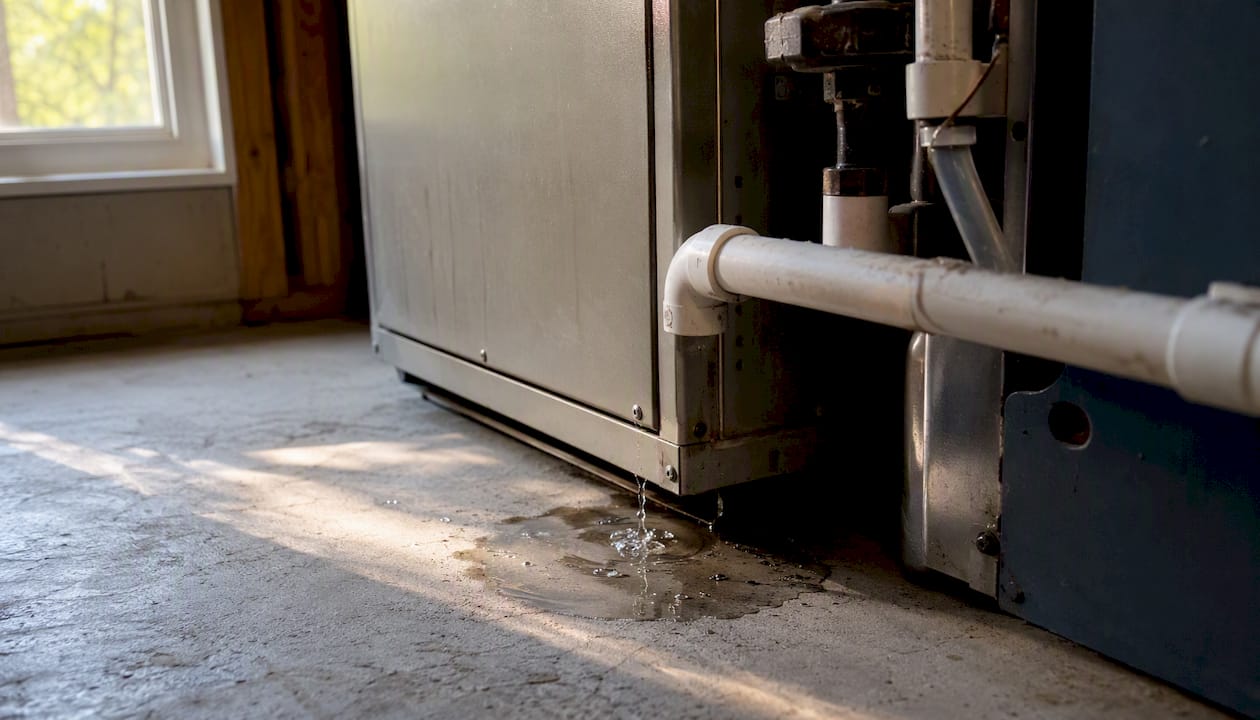
Most furnace leaks trace back to a clogged condensate drain on a high-efficiency condensing furnace. For non-condensing furnaces with a metal flue, the water usually points to a whole-house humidifier fault or a shared AC evaporator coil drain.
Before you do anything else: shut the furnace off at the thermostat, then flip the circuit breaker. Water near electrical components is a real hazard. Once the system is off, lay down towels, mop up standing water, and place a bucket under any active drip.
Quick checks you can do right now:
- Look for a white PVC pipe (about ¾ inch wide) exiting through an exterior wall near the furnace. That is your condensate drain termination.
- Check whether the small plastic condensate pump box near the furnace has water overflowing from it.
- Look at the floor drain or utility sink where the drain line empties indoors. Is it backed up?
Pro Tip: Before calling anyone, take a wet/dry vacuum to the outdoor end of the condensate drain pipe. Seal the vac hose over the opening, run it for 30 seconds, then pour one cup of distilled white vinegar into the indoor cleanout tee. This single step clears the majority of clog-related leaks and often saves a service call entirely.
Key Takeaways
A clogged condensate drain is the most likely cause of a furnace water leak on a high-efficiency unit, and a wet/dry vacuum plus a vinegar flush resolves most cases in under an hour.
| Point | Details |
|---|---|
| First action | Shut off the furnace at the thermostat and breaker before touching anything. |
| Most likely DIY fix | Vacuum the outdoor drain termination and flush with one cup of white vinegar. |
| Know your furnace type | PVC pipes mean condensing (water is normal); metal flue means water should not be present. |
| Call a pro when | Water is inside the cabinet, CO detector trips, or the leak returns after cleaning. |
| Ricottaheatingandair | Offers same-day furnace leak diagnosis and repair in Jefferson County and the St. Louis area. |
Table of Contents
- Why is your furnace leaking water? Seven common causes
- How to tell if you have a condensing or non-condensing furnace
- What to do the moment you find water around the furnace
- How to fix a furnace condensate drain yourself
- When should you call an HVAC professional?
- Simple maintenance steps that prevent most leaks
- A local technician’s perspective on furnace leaks
- Ricottaheatingandair is ready to help with your furnace leak
- Sources
Why is your furnace leaking water? Seven common causes
Clogged condensate drains top the list for high-efficiency furnaces, but there are six other causes worth knowing. Each one leaves slightly different clues.
| Cause | How common | DIY feasible? | Typical pro cost |
|---|---|---|---|
| Clogged condensate drain | Very common | Yes, if termination is accessible | $100 to $300 |
| Failed condensate pump | Common | Pump swap is DIY-friendly | $200 to $600+ |
| Cracked condensate trap or line | Moderate | No — requires disassembly | $75 to $250 |
| Whole-house humidifier fault | Moderate | Pad/valve swap is DIY | $100 to $300 |
| Clogged secondary heat exchanger | Less common | No — pro only | $200 to $600+ |
| Improper vent pipe slope | Less common | No — requires re-sloping | $200 to $600+ |
| AC evaporator coil drain issue | Seasonal (summer) | Partial DIY | $75 to $250 |
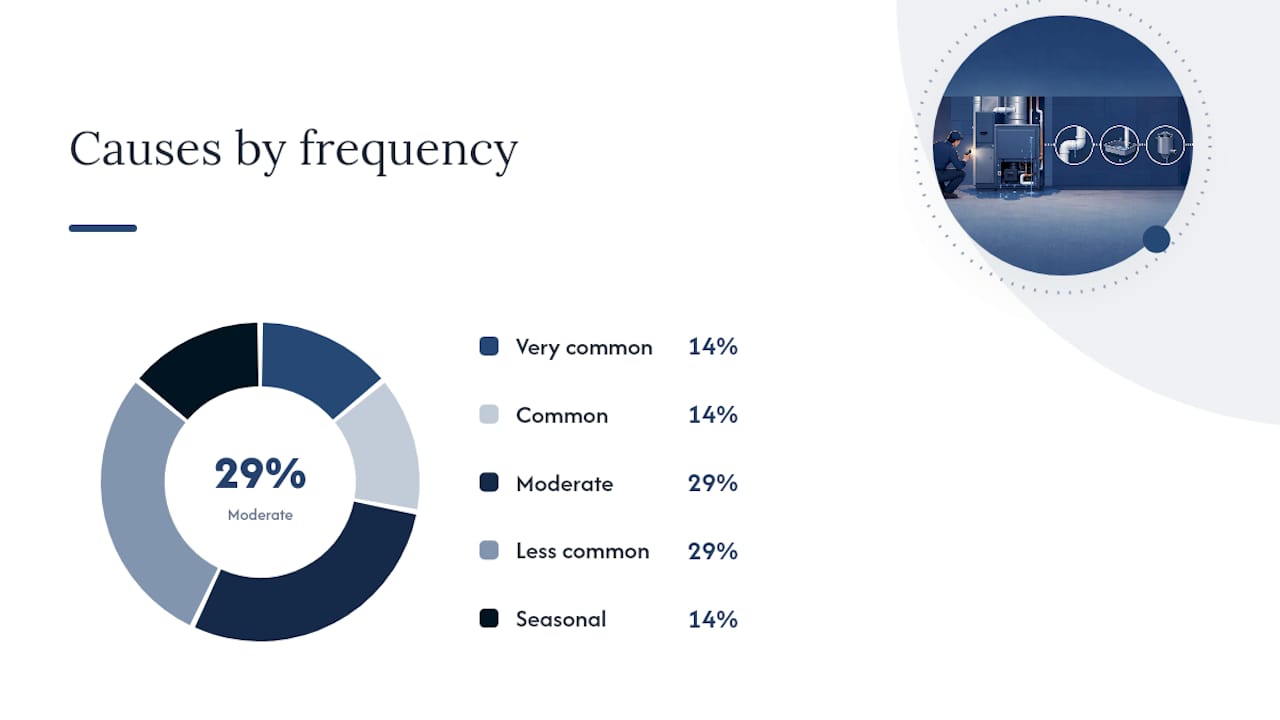
Here is what each one looks like up close:
1. Clogged condensate drain. Algae and biofilm build up inside the PVC drain line over months. Water backs up and overflows at the furnace. You will see a puddle directly under the unit or near the pump box.
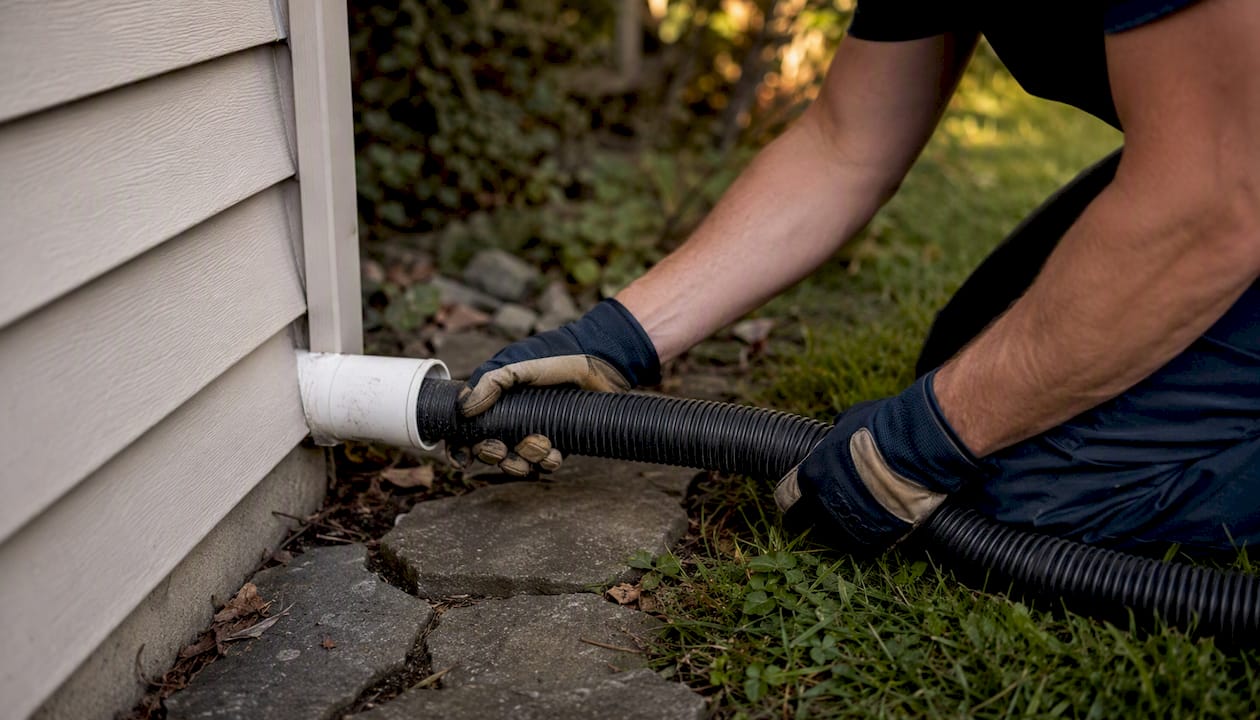
2. Failed condensate pump. The pump sits in a small plastic reservoir and pushes water to a drain when the float rises. When the motor burns out or the float sticks, the reservoir overflows. Condensate pumps have a limited lifespan and may require replacement after several years of use.
3. Cracked condensate trap or line. The trap is a U-shaped section of PVC that holds a small water seal. A crack or loose joint lets water drip inside the cabinet. You will often see mineral staining or wet insulation around the base of the furnace.
4. Whole-house humidifier fault. If your furnace has a humidifier mounted on the side, a cracked water panel tray, a stuck supply valve, or a failed drain line can send water straight to the floor. Leaks that happen only during the heating season and stop in summer often point here.
5. Clogged secondary heat exchanger. High-efficiency furnaces have a secondary heat exchanger that extracts additional heat from exhaust gases and produces condensate in the process. When it clogs, water backs up internally.
IMPORTANT: A cracked heat exchanger is a carbon monoxide risk. If you smell something odd, your CO detector trips, or you see soot near the furnace, shut the system off immediately and call a professional. Do not restart it.
6. Improper vent pipe slope. Condensate in the flue pipe needs to drain back toward the furnace. If someone installed the vent with the wrong slope, water pools in the pipe and eventually leaks at a joint.
7. AC evaporator coil or air handler drain issues. When your AC runs, the evaporator coil produces condensate that drains through the same line as the furnace. A clogged evaporator coil drain in summer can look exactly like a furnace leak. If the puddle appears only when the AC is running, start there.
How to tell if you have a condensing or non-condensing furnace
This distinction changes everything about your diagnosis. Condensing furnaces (90%+ AFUE) are designed to produce water as a byproduct of combustion. Non-condensing furnaces should never produce water at all.
| Feature | Condensing (90%+ AFUE) | Non-condensing |
|---|---|---|
| Vent pipe material | White or gray PVC | Metal flue pipe |
| Condensate drain line | Present (PVC, ¾ in.) | Absent |
| Normal water production | Yes | No |
| Common failure modes | Clogged drain, pump, trap | Humidifier, AC coil, vent slope |
How to check yours in 60 seconds:
- Look at the pipes leaving the top or side of the furnace. PVC = condensing. Metal = non-condensing.
- Check the furnace cabinet for an AFUE sticker. A number at or above 90 confirms a condensing unit.
- Look for a small plastic box (the condensate pump) or a drain line running to a floor drain or utility sink.
If you have a non-condensing furnace and water is pooling nearby, the furnace itself is not the source. Check the humidifier, the AC air handler drain, or look for a plumbing leak above.
What to do the moment you find water around the furnace
Shut the furnace off at the thermostat first, then go to the breaker panel and cut power to the furnace circuit. If water is touching any electrical panel, outlet, or wiring, cut power to that area of the house before you step closer.
Containment checklist:
- Lay old towels or absorbent mats around the base of the furnace.
- Place a bucket under any active drip point.
- Mop up standing water with a wet/dry vacuum or towels.
- If water has reached a finished floor or drywall, pull back the material and run a fan to dry it out. Mold can begin growing within 24–48 hours on wet materials.
Do this / don’t do that:
- ✅ Photograph the puddle, the drain line, and the furnace label before you clean up. Date-stamped photos are useful for insurance claims and give your HVAC tech a clear picture of what you found.
- ✅ Check the outdoor drain termination for visible blockage (mud, insects, ice in winter).
- ❌ Do not open sealed combustion compartments on the furnace.
- ❌ Do not restart the system with exposed wiring or standing water near electrical components.
Pro Tip: Snap a photo of the furnace data plate (model number, AFUE rating, serial number) while you are down there. Your technician will need it, and having it ready speeds up the diagnostic call.
How to fix a furnace condensate drain yourself
If the leak is coming from a condensate drain issue and the outdoor termination is accessible, you can often clear it in under an hour. This vacuum-and-vinegar approach resolves most clog-related leaks without any special tools.
What you need: wet/dry shop vacuum, distilled white vinegar (1 cup), a funnel or turkey baster, flashlight, pliers, and a few old towels.
Step-by-step: clearing the condensate drain
- Turn the system off at the thermostat and breaker before touching anything.
- Find the outdoor drain termination. It is usually a small PVC pipe stub exiting through the foundation or an exterior wall near the furnace. In some homes it drains to a floor drain or utility sink instead.
- Vacuum the outdoor end. Press the wet/dry vac hose firmly over the pipe opening to create a seal. Run it for 30 seconds. You may hear a gurgle and pull out a plug of algae or debris.
- Locate the indoor cleanout tee. This is a T-shaped fitting on the drain line, usually near the furnace, with a removable cap. Not all systems have one — if yours does not, skip to step 6.
- Pour in the vinegar. Using a funnel, slowly pour one cup of distilled white vinegar into the cleanout tee. Let it sit for 30 minutes to break down biofilm and algae.
- Flush with water. Pour a cup of plain water through the cleanout to rinse the line. Watch the outdoor termination — water should flow freely.
- Restore power and run the system. Watch for 10–15 minutes. No new puddle means you cleared the clog.
Checking and replacing a condensate pump
Open the pump lid and look inside the reservoir. If it is full of water and the pump is not running, manually lift the float with your finger. If the motor kicks on, the float is stuck and needs cleaning or replacement. If nothing happens, the motor is likely burned out. Condensate pump replacements are straightforward: unplug the old unit, disconnect the inlet and outlet lines, and swap in a new pump of the same size. Most hardware stores carry universal replacements.
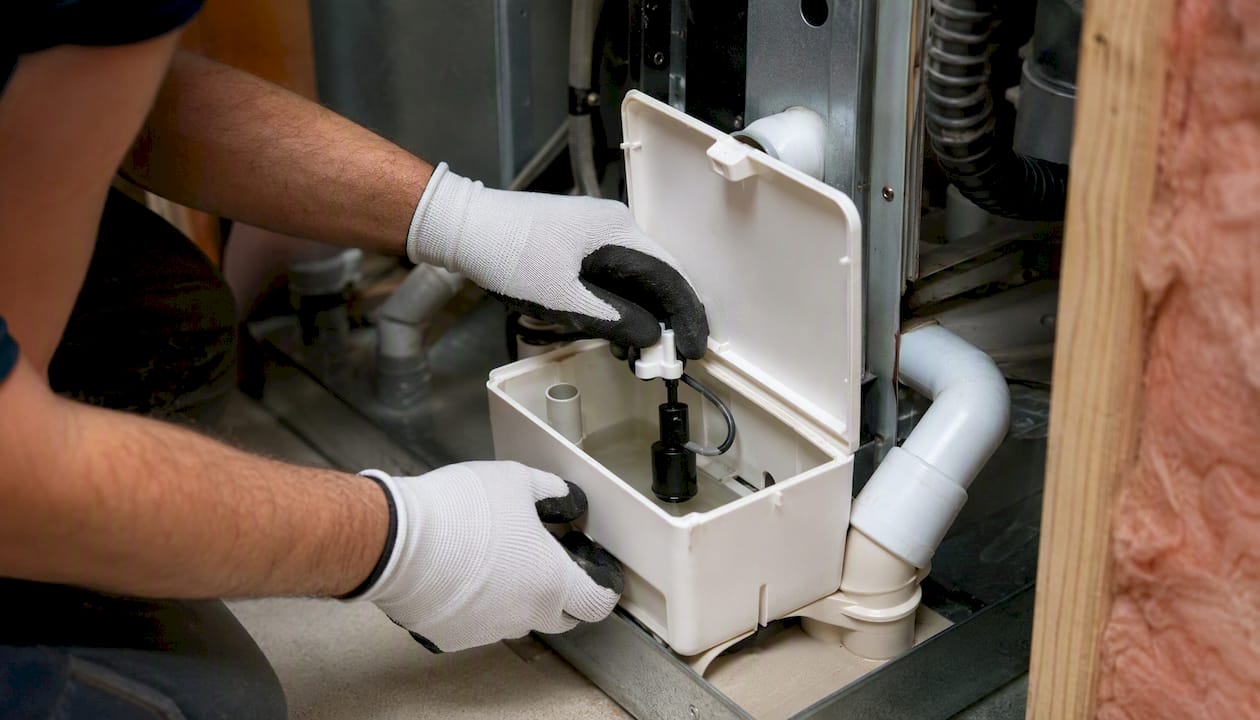
Simple humidifier fixes
Check that the water supply valve to the humidifier is fully open. Remove the humidifier cover and inspect the water panel (evaporator pad) for heavy mineral buildup — a clogged pad can cause overflow. Replace the pad if it looks caked with white scale. Also check the drain hose at the bottom of the humidifier for kinks or blockages.
Stop and call a pro if:
- Water is dripping inside the furnace cabinet itself.
- The condensate trap is glued in place and you cannot remove it. Glued traps require professional service to avoid cracking the fitting.
- The drain line runs through a finished wall with no accessible cleanout.
- You see any wiring that has been wet.
When should you call an HVAC professional?
Call a pro any time you see water inside the furnace cabinet, the leak persists after a DIY drain cleaning, or you suspect a cracked heat exchanger. Those situations go beyond what a homeowner should handle.
Red flags that mean call now:
- Water dripping from inside the furnace cabinet or from the heat exchanger area.
- Your CO detector has tripped or you smell a faint exhaust odor near the furnace.
- The furnace is showing error codes on the display (a flashing LED sequence).
- The leak keeps coming back within days of cleaning the drain.
- Any wiring near the furnace has been wet.
- Humid air problems throughout the house alongside the leak, which can signal a humidifier or coil issue beyond the drain.
For emergency furnace repair in Jefferson County, do not wait if you see any of the above.
What a technician will inspect: the condensate drain and trap, the condensate pump, vent pipe slope, the secondary heat exchanger, the humidifier supply and drain, and the evaporator coil drain pan. Tell the tech when the leak started, whether the AC or heat was running at the time, and share those date-stamped photos you took earlier.
Typical professional repair costs (sourced from Angi’s repair cost data):
| Repair | Typical cost range |
|---|---|
| Condensate line clear | $100 to $300 |
| Condensate pump replacement | $200 to $600+ |
| Trap or line repair | $75 to $250 |
| Secondary heat exchanger work | $200 to $600+ |
Simple maintenance steps that prevent most leaks
Routine upkeep prevents the majority of furnace water leaks. The steps below take less than 15 minutes per quarter and cost almost nothing.
Quarterly homeowner checklist:
- Pour one cup of distilled white vinegar into the condensate cleanout tee. This keeps algae and biofilm from building up and is the single most effective thing you can do between tune-ups.
- Inspect the outdoor drain termination for mud, insect nests, or ice blockage.
- Check the humidifier supply valve and water panel for scale buildup.
- Replace the air filter every 1–3 months. A clogged filter restricts airflow, causes the coil to freeze, and can contribute to drain overflow when the ice melts.
Annual recommendations:
- Schedule a professional furnace tune-up each fall before heating season. A tech will clean the secondary heat exchanger, check the trap, and verify vent slope.
- Book an AC tune-up each spring. The evaporator coil and its drain pan share the same drain line as your furnace on most systems.
- Inspect the condensate pump every year and budget for replacement every 3–8 years.
If a leak does occur, dry the area thoroughly within 24–48 hours to prevent mold growth. A box fan aimed at the wet spot and an open window is enough for minor spills. For larger leaks that soaked into drywall or subfloor, consider an indoor air quality check after the repair to confirm no mold has taken hold.
A local technician’s perspective on furnace leaks
At Ricottaheatingandair, the most common call we get in St. Louis and Jefferson County homes is a high-efficiency furnace with a condensate drain that has not been touched since installation. The drain line fills with algae, the pump reservoir overflows, and the homeowner finds a puddle on a cold January morning. Nine times out of ten, a vacuum and a vinegar flush fix it.
What we also see regularly is homeowners who waited too long after spotting the first small drip. That 24–48 hour mold window is real. A damp utility room in a St. Louis winter can develop mold behind drywall faster than most people expect.
When a Ricottaheatingandair technician arrives, you get a straight diagnosis with no pressure to replace parts that do not need replacing. We check the drain, the pump, the trap, the vent slope, and the heat exchanger in a single visit. If it is a simple drain clear, we tell you that. If it is a cracked heat exchanger with a CO risk, we tell you that too, plainly and without alarm.
If you smell exhaust near the furnace or your CO detector has gone off, treat it as an emergency. Shut the system down, open a window, get everyone out, and call us.
Ricottaheatingandair is ready to help with your furnace leak
When the DIY steps do not resolve the leak, or you are not comfortable getting into the system yourself, Ricottaheatingandair offers same-day diagnostics and repairs for furnace leaks throughout Jefferson County and the St. Louis area. No waiting a week for an appointment when your utility room floor is wet.

Relevant services you can book today:
- Emergency furnace repair and condensate system diagnosis
- Condensate pump replacement and drain line clearing
- Whole-house humidifier inspection and servicing
- Annual HVAC maintenance plans that include condensate drain cleaning, filter replacement, and full system checks each fall and spring
Ricottaheatingandair services all major brands, including Trane, Carrier, Lennox, and Rheem. Pricing is transparent before any work begins. For homeowners in Mehlville, Cedar Hill, Manchester, and surrounding communities, local furnace and AC repair is a phone call away. Call us or use the online form at ricottaheatingandair.com to schedule your visit.
Sources
- Furnace Leaking Water? Causes, Signs, and Repair Steps | Carrier
- How to Clean a Condensing Furnace Drain (Homeowner Guide)
- Furnace leaking water — causes and fixes
- Quick answer: The AC condensate drain line is a PVC pipe that carries water from the indoor coil to outside.