
Frozen AC Unit: What to Do Right Now
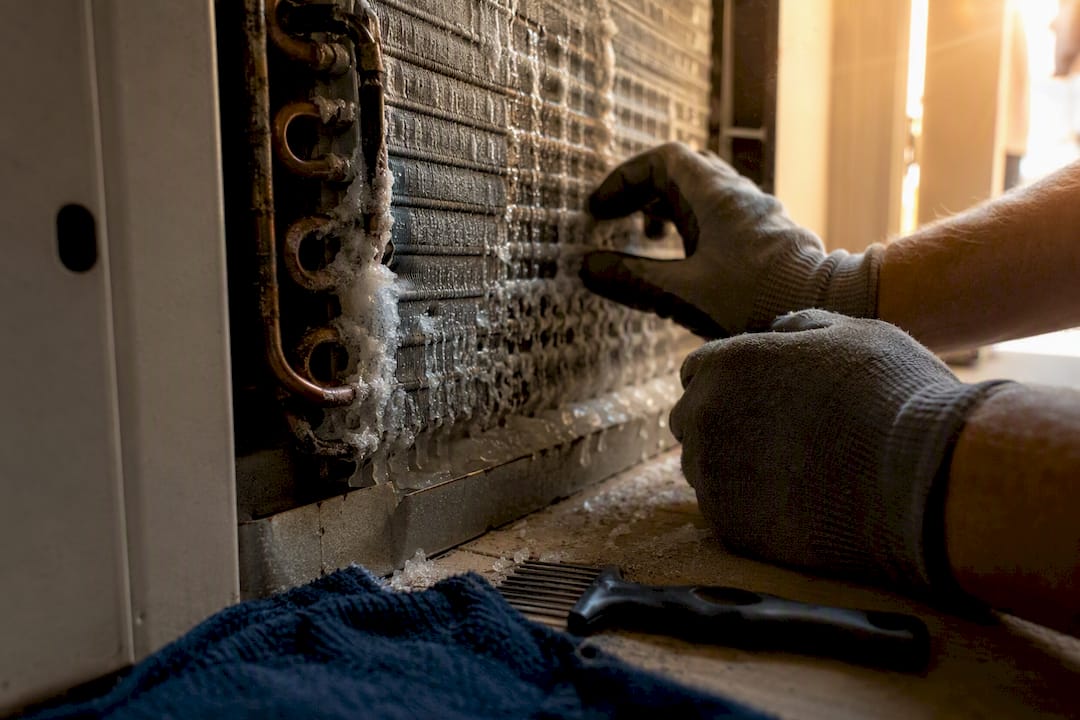
If you spot ice on your air conditioner, turn the thermostat from COOL to OFF, flip the fan setting to ON, and let the coil thaw before you touch anything else. Running a frozen air conditioning system risks compressor damage that turns a $200 fix into a $2,000 one.
Here’s the order of operations:
- Set the thermostat mode to OFF, then switch the fan to ON (not AUTO).
- Check the air filter. If it’s gray and packed with dust, pull it.
- Clear the floor around the indoor air handler. It’s about to drip.
- Note how long the system has been running and any strange sounds you heard beforehand.
IMPORTANT: Never chip at the ice or aim a hair dryer, heat gun, or hot water at the coil. Thermal shock cracks coil fins and fries electronics. And don’t try to force a cycle “to see if it clears” — a frozen evaporator coil can send liquid refrigerant back into the compressor, a problem technicians call slugging, and it can wreck the compressor in one cycle.
Pro Tip: Slide a shallow pan or a few old towels under the air handler before you walk away. Snap a photo of the frost line on the refrigerant line, too — it’s the first thing a technician will ask about.
A thin layer of ice on the coil insulates it and chokes off airflow even further, which is exactly why a small freeze becomes a solid block within a few hours.
Key Takeaways
A frozen AC unit thaws safely only when cooling is shut off, the fan runs alone, and the underlying airflow or refrigerant problem gets fixed before you restart.
| Point | Details |
|---|---|
| Act on the freeze immediately | Turn cooling OFF, fan to ON, and let the coil thaw naturally for 1 to 4 hours. |
| Never force the ice | Chipping ice or using heat tools cracks coil fins and can fry electronics. |
| Check the filter first | A dirty filter is the leading cause of coil freezing and the easiest DIY fix. |
| Call a pro after refreeze | Repeat freezing, oily residue, or hissing sounds mean it’s beyond DIY territory. |
| Ricotta handles the diagnosis | Ricotta Heating & Air offers emergency diagnosis, leak repair, and coil cleaning across St. Louis and Jefferson County. |
Table of Contents
- How to Tell if Your AC or Evaporator Coil Is Frozen
- What Causes an AC to Freeze Up in the First Place
- How to Safely Thaw and Restart a Frozen AC Unit
- When Should You Call an HVAC Technician?
- How to Prevent Your AC From Freezing Again
- Why a Small Amount of Ice Turns Into a Big Problem Fast
- If You Need Help Now: How Ricotta Heating & Air Handles Frozen AC Calls
- Sources
How to Tell if Your AC or Evaporator Coil Is Frozen
You don’t need to pull a panel off to confirm a freeze. Start at the vents: air that’s weak, warm, or barely moving at all is the first tell. Walk to the outdoor unit and the indoor air handler and look for frost creeping along the copper refrigerant line, or actual ice building up on the cabinet itself. Puddles near the furnace or air handler are meltwater from a coil that’s already thawing on its own, which usually means it froze hours earlier.
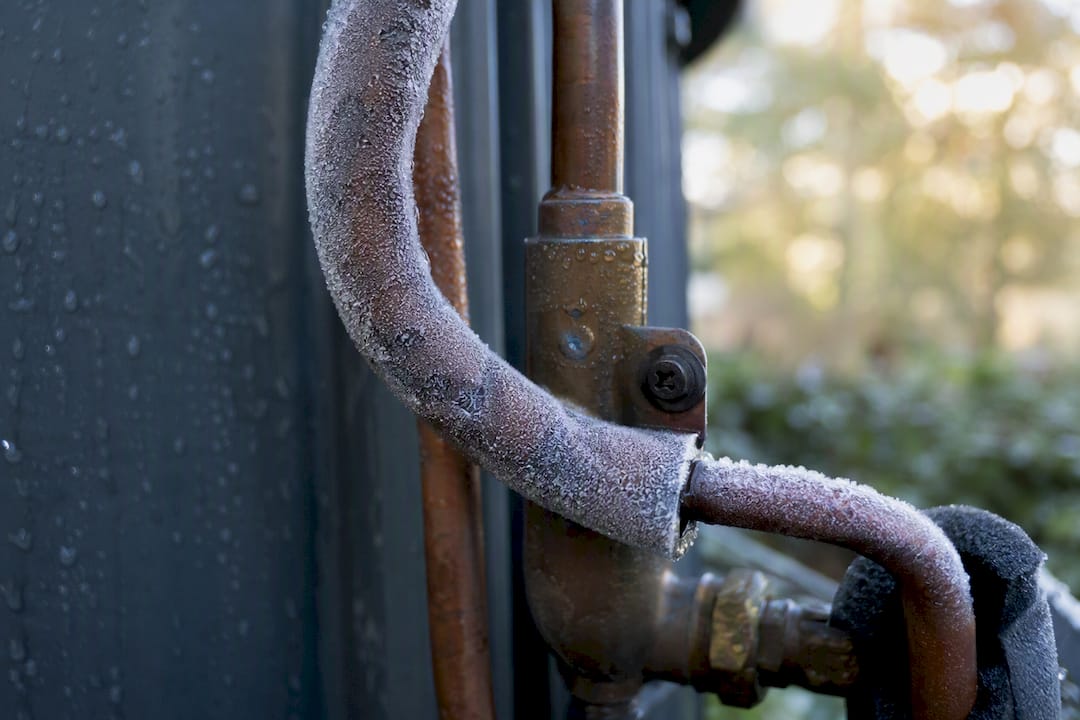
Listen, too. A system that’s been running nonstop for far longer than usual, or one making a hissing or bubbling noise, may be leaking refrigerant. A sudden jump in your electric bill with no change in habits often means the compressor has been struggling against restricted airflow for days before you noticed the ice.
Run through this in under five minutes:
- Feel the airflow at two or three vents. Weak or warm air is your first clue.
- Look at the copper line where it enters the house. Frost or ice means a freeze.
- Check for water pooling near the indoor unit.
- Listen for hissing, bubbling, or a compressor that won’t shut off.
Skip the urge to open the coil housing or scrape visible ice with a screwdriver. According to Trane, even a thin ice layer accelerates its own growth by cutting airflow further, so what looks minor now can be a solid block within a couple of hours.
What Causes an AC to Freeze Up in the First Place
Nearly every frozen AC unit traces back to one of five problems, and they range from a five-minute fix to a call you shouldn’t put off.
Restricted airflow is the most common culprit by a wide margin. A dirty filter, closed dampers, furniture blocking a return vent, or too many supply vents shut can all starve the coil of the warm air it needs to stay above freezing. Less air moving across the coil means the refrigerant inside gets colder than it should, and condensation on the coil surface turns to ice instead of draining away. HouseWiseLab points to a clogged filter as the single leading cause of coil freezing, and it’s also the one homeowners can fix themselves in minutes. Check the filter first, every time.
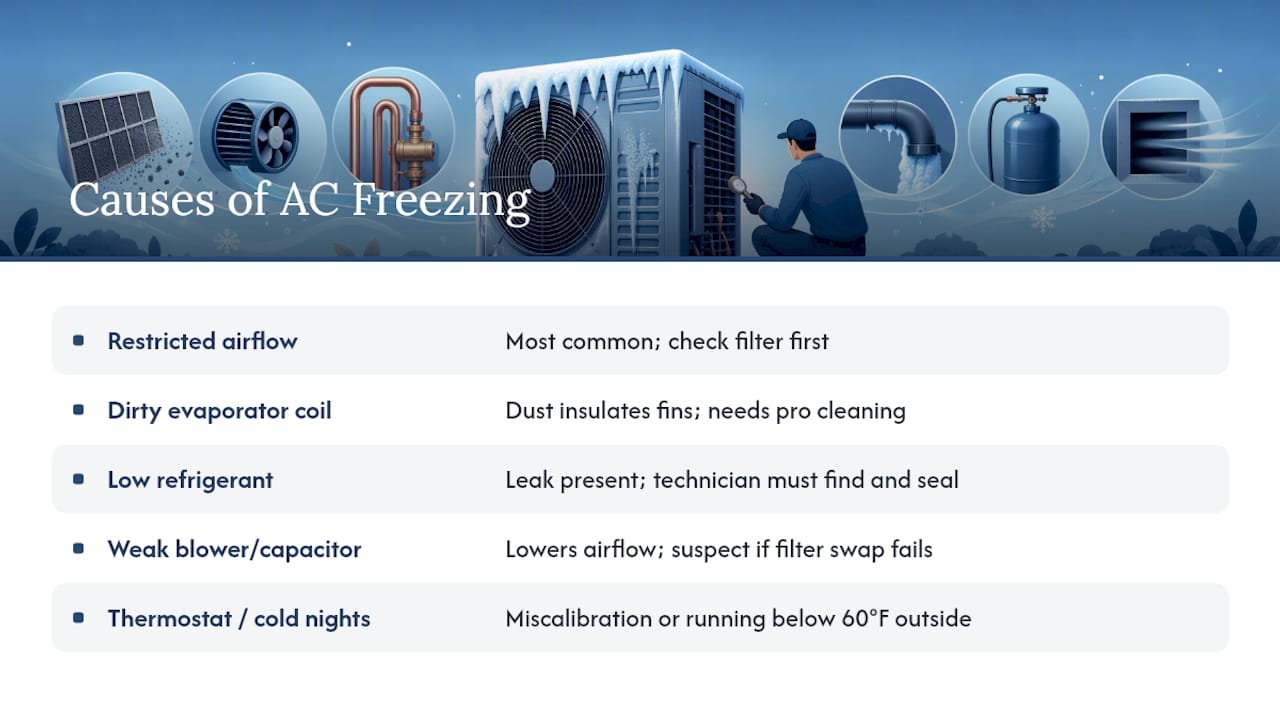
A dirty evaporator coil creates the same problem from the inside. Dust and grime act like a thin blanket over the coil’s fins, insulating it just enough to drop surface temperatures and invite ice. This one usually needs a professional coil cleaning rather than a DIY fix, since the coil sits inside sealed ductwork.
Low refrigerant from a leak drops pressure in the system, and lower pressure means a colder coil surface. This is not a top-off-and-forget situation. Refrigerant doesn’t get “used up” the way gas in a car does. If the level is low, something is leaking, and a licensed technician needs to find and seal it before adding more.
A weak blower motor or a failing capacitor mimics a dirty filter almost perfectly. Airflow drops, the coil gets too cold, and ice forms even with a brand new filter installed. If you swapped the filter and the freeze comes back, the blower is worth suspecting next.
Thermostat problems and cold outdoor nights round out the list. A miscalibrated thermostat can keep the compressor running far longer than the space actually needs, and running central air when it’s below 60°F outside can push coil temperatures into freezing range on its own, according to guidance from Icy Hot Air Conditioning Repair.
Pro Tip: If your AC keeps freezing overnight but runs fine during the hot part of the day, check what temperature it’s dropping to outside after dark. You may just need to switch to fan-only once the evening cools off.
How to Safely Thaw and Restart a Frozen AC Unit
Follow these five steps in order, and don’t skip ahead to restarting before the coil is fully clear.
- Turn the thermostat mode to OFF, fan to ON. This circulates room-temperature air across the coil without asking the compressor to do any more work, which is the safest way to melt ice without stressing the system.
- Replace the air filter and open every vent and return. Move furniture, rugs, or boxes blocking a return grille. Restricted airflow got you here in the first place.
- Let it thaw naturally. Most units clear in one to four hours depending on how thick the ice was. Check your meltwater pan or towels periodically so they don’t overflow.
- Inspect the condensate drain. If water is backing up instead of draining, a wet/dry vacuum at the outside access point or a careful flush with water often clears a minor clog.
- Restart and watch it for 30 to 60 minutes. Once the coil is visibly ice-free and the filter is fresh, switch back to COOL and confirm the vents are blowing cold air steadily, with no signs of ice re-forming.
Never point a hair dryer, heat gun, or hot water at the coil to speed things up. Manufacturer guidance is consistent on this: thermal shock cracks coil fins and can fry the control board, turning a simple freeze into an expensive repair.
Refrigerant lines, the compressor, and anything behind a sealed panel are off limits for DIY work. If the freeze traces back to low refrigerant, that’s licensed-technician territory, not a project for a Saturday afternoon.
When Should You Call an HVAC Technician?
Some situations call for a phone call, not another thaw-and-hope cycle. Book a technician if you see any of the following:
- The unit refreezes after a full thaw and a fresh filter.
- You notice oily residue on the refrigerant lines, a classic sign of a leak.
- Hissing or bubbling continues even after the system is off.
- The blower runs weak despite a clean filter and open vents.
- Water has pooled enough to threaten flooring, drywall, or electrical components.
When a technician arrives, expect them to confirm the coil is fully thawed first. They genuinely can’t take accurate pressure readings on a block of ice, and showing up to one wastes both your time and theirs, according to American Standard. From there, they’ll check refrigerant pressure, test the blower motor and capacitor, clean the coil, inspect the condensate pan and drain, and run a leak detection test if pressures look low.
Pro Tip: Before your appointment, snap photos of the iced-over line, note how many hours the system ran before you noticed the problem, and have your filter (old and new) handy. It cuts diagnostic time in half.
If refrigerant is involved, only an EPA Section 608 certified technician can legally handle it, which rules out any “quick fix” a neighbor offers to try.
How to Prevent Your AC From Freezing Again
A little routine maintenance keeps most homeowners from ever seeing ice on their coil again.
- Replace the filter every one to three months during cooling season, more often with pets or heavy dust, using a MERV 8 to 11 filter for most residential systems.
- Keep return and supply vents open. Closing off more than a couple of rooms throws off the airflow balance the whole system depends on.
- Book an annual spring tune-up that covers coil cleaning, refrigerant level check, blower inspection, and condensate drain clearing, a habit that Morelli Air notes catches small issues before they cause a summer freeze-up.
- Avoid running cooling when outdoor temperatures drop below roughly 60°F, and watch for a thermostat that seems to run the system far longer than the house actually needs.
- Furniture-blocked returns are one of the sneakiest causes homeowners overlook.
- A recurring freeze after maintenance almost always points to refrigerant or blower issues, not the filter.
Why a Small Amount of Ice Turns Into a Big Problem Fast
Ice doesn’t grow at a steady pace. A thin layer on the coil insulates the metal and chokes airflow even more, which lets the next layer form faster than the last, a pattern Trane calls the snowball effect. Left running, that buildup pushes liquid refrigerant back toward the compressor instead of vapor, a condition called slugging that can destroy the compressor in a single cycle.
A frozen coil is not a problem that waits patiently for your schedule. The ice you see at 8 a.m. is rarely the ice you’ll have by noon.
Pro Tip: Technicians can’t run pressure diagnostics on a solid block of ice, so calling for service the moment you spot frost, without letting it run for “just one more day,” gets you a faster and more accurate diagnosis.
A Note on Common Homeowner Mistakes
The mistakes I see repeated most: chipping at ice, topping off refrigerant without fixing the leak, and waiting out a second freeze instead of calling. Set a recurring reminder for filter checks and your spring tune-up. It solves most of this before it starts.
If You Need Help Now: How Ricotta Heating & Air Handles Frozen AC Calls
A frozen coil rarely announces itself politely, and once you’ve thawed it, gotten the fan running, and confirmed it’s holding steady, the next honest question is whether it’ll happen again. That’s where we come in. Ricotta Heating & Air handles emergency diagnosis, refrigerant leak detection and repair, coil cleaning, and blower or thermostat repairs for homeowners across St. Louis and Jefferson County, without the upsell pressure some larger outfits are known for.

Before we arrive, have your filter out (old or new, either helps), the thaw mostly complete, and a few photos of the ice buildup ready. It saves diagnostic time and gets your system back to cooling faster. We service all major brands, including Trane systems, and back our work with 50 years of local expertise and more than 150 five-star Google reviews from neighbors who’ve been exactly where you are right now. If the freeze keeps coming back, or you’d rather have a trained eye confirm the fix the first time, schedule a diagnostic visit and get it handled properly.
Sources
- Frozen evaporator coil causes | Trane
- Will Frozen AC Fix Itself? | Carrier
- Got a Frozen Evaporator Coil? Don’t Panic | American Standard®
- AC evaporator coil frozen symptoms: how to spot a freeze and what to do next - HouseWise
For anything specific to your home, a licensed technician remains the best source.