
Quick Summary
Duct leaks can leave rooms warm even while the AC runs. Supply leaks let cooled air escape, while return leaks can draw hot, humid air into the system. For homeowners in Jefferson County, room-by-room airflow and temperature checks are useful starting points—not proof of a leak. Warm air throughout the house can indicate an equipment problem or a major duct issue; trouble in just a few rooms may point to ducts, dampers, or airflow balance.
- Check accessible joints, seams, and branch connections for visible gaps.
- Hold a tissue near each supply register to compare airflow, not measure it.
- Compare supply and return temperatures after the cooling system has run steadily.
- Check thermostat settings, filters, and blocked vents before assuming the ducts are leaking.
- Have a technician reconnect and support a separated duct; tape alone is not a repair.
Table of Contents
- Why Duct Leaks Send Warm Air Through Your Vents
- Signs of Leaking Air Ducts You Can Check Yourself
- How to Test Airflow From Vents and Read the Results
- Warm Air From AC Vents: Ruling Out Other Causes First
- Disconnected HVAC Duct Symptoms That Point to a Bigger Break
- Where Leaks Hide: Seams, Connections, and Supply Ducts
- DIY Inspection Limits and When to Call a Technician
- Schedule a Duct Leak Inspection With Ricotta Heating & Air
- Frequently Asked Questions
Why Duct Leaks Send Warm Air Through Your Vents
If your Hillsboro home has warm air coming from the vents during a cooling cycle, the system may not be cooling properly—or cooled air may not be reaching the rooms that need it.
Your indoor coil cools the air, and the blower moves it through the ductwork. Problems along that route can reduce comfort even when the equipment is running.
Duct leakage is air escaping from or entering the duct system through gaps, cracks, and loose connections.
How Leaky Ducts Lose Cooling Before It Reaches the Room
Think of your ducts as a delivery route for conditioned air.
Supply ducts carry air under positive pressure, so openings let cooled air escape before it reaches the registers. Return ducts operate under negative pressure and can pull unwanted air through gaps.
If both sides leak into unconditioned spaces, less cooling reaches the rooms while warm, humid air adds to the AC's workload. A supply leak alone may reduce airflow without making the remaining air noticeably warmer.
Attics, Crawlspaces, and Unconditioned Space
During Missouri's humid summers, a hot attic or damp crawlspace can make duct problems more noticeable. Attic air can be much hotter than outdoor air on a sunny afternoon.
Supply leaks waste cooled air in these unconditioned spaces. Return leaks can draw in heat, moisture, and dust. Missing or damaged duct insulation also lets air pick up heat along the way.
Proper insulation limits heat transfer, but it does not seal leaks. Ducts inside conditioned space are less exposed to outdoor temperature extremes. During cold winters, supply leaks outside that space can waste heated air, too.
Signs of Leaking Air Ducts You Can Check Yourself
Uneven temperatures, weak airflow, unexplained increases in energy use, and persistent stuffiness can all suggest a duct problem.
Walk through your home and look for these clues:
- Rooms near the air handler feel cool while rooms farther away stay warm.
- Some registers move plenty of air while others barely move a tissue.
- Dust collects around certain registers.
One warm room does not prove there is a leak. Sun exposure, insulation, duct sizing, and other airflow problems can cause similar symptoms.
How to Test Airflow From Vents and Read the Results
An airflow comparison and a temperature check can give a technician useful clues. Neither test confirms a leak. Start with airflow, since restrictions can affect temperature readings.
Step 1: The Tissue Airflow Test
Hold a tissue near each supply register while the AC is actively cooling. Keep hold of it and avoid blocking the grille. More movement generally means more air is reaching that spot, but grille shape and tissue position affect the result. Write down the differences:
- Strong everywhere: No obvious weak spots show up in this rough check; compare temperatures next.
- Weak in distant rooms only: A long duct run, closed damper, crushed duct, leak, or balancing issue may be involved.
- Weak everywhere: Check the filter and return grilles; a technician may need to inspect the blower and duct system.
Step 2: Measure Supply-Air Temperature
Use a thermometer designed to measure air temperature. Let the AC run for about fifteen minutes, then hold the probe in the supply airstream without touching the grille. Record the reading and take another at a return grille. An infrared thermometer reads surface temperature, not the air itself.
Keep the conditions consistent:
- Take readings while the system is actively cooling, not between cycles.
- Keep registers open and check that the filter is clean.
- Repeat readings at each register to see whether they stay consistent.
Step 3: Interpret the Difference
Compare the supply temperature with the return temperature. During cooling, supply air should be cooler. A small difference can reflect an equipment problem, duct heat gain, return leakage, or operating conditions. Humidity and airflow affect the readings, so a grille temperature check cannot diagnose refrigerant charge or confirm a duct leak.
Step 4: Compare Rooms
Measure the same way at a register near the air handler and one in a distant room. Warmer air or weaker flow at the distant register may suggest heat gain, restricted airflow, or leakage along that run. Although cleaning air ducts may address certain debris problems, it does not repair open seams or disconnected ducts.
For a closer look at one stubborn room, see weak airflow in one room and the door test. If the problem affects the whole house, review the warning signs of a dirty evaporator coil as well.
Warm Air From AC Vents: Ruling Out Other Causes First
Warm air from AC vents does not automatically mean the ducts are leaking. Start with the checks you can safely make before arranging a diagnosis.
The thermostat, filter, and registers are homeowner checks. Refrigerant, electrical components, and internal equipment problems need a technician.
1. Thermostat and Mode Settings
Confirm the thermostat is set to COOL and below the room temperature. Set the fan to AUTO rather than ON. A fan set to ON runs between cooling cycles and may move room-temperature air that feels warm compared with cooled air. If you have a heat pump, make sure it is in cooling mode.
2. Air Filter
A clogged filter restricts airflow and can contribute to poor cooling or a frozen indoor coil. Turn the system off before checking the filter, and replace it according to the equipment and filter instructions. Use the correct size and recommended filter type. See HVAC Proper Installation of Filters for more information.
3. Closed or Blocked Vents
Move furniture and rugs away from supply registers and return grilles. Keep supply registers open unless a technician has advised otherwise. If you have closed vents in unused rooms, read why closing vents can raise your bill. Closing registers can change airflow and pressure throughout the system.
4. Outdoor Unit and Refrigerant
A dirty outdoor coil, refrigerant problem, or compressor fault can reduce cooling even when the ducts are intact. From a safe distance, look for grass clippings, leaves, or cottonwood fluff blocking the outdoor coil. Do not remove panels or reach inside. Refrigerant testing and repairs require a qualified HVAC technician.
5. Indoor Coil and Airflow Restrictions
A dirty evaporator coil, blower problem, or blocked return can reduce airflow and cooling. If you see ice on refrigerant lines or the indoor coil, turn cooling off and call for service. Do not chip away the ice or keep running the AC to see whether it clears.
6. Duct Leaks and Disconnects
If the basic checks do not help, have the equipment and ducts evaluated together. Visit AC repair and cooling services in Jefferson County, MO to request help. A leaking or disconnected branch may leave one room warm while other rooms cool normally, but the pattern alone does not identify the cause.
Sealing ducts without finding the cause may leave the original problem unresolved. Diagnose first, then repair what needs attention.
Disconnected HVAC Duct Symptoms That Point to a Bigger Break
A separated supply duct can release conditioned air into an attic or crawlspace instead of delivering it to a room. The change may be much more noticeable than a small seam leak.
Look for these signals:
- One room or zone stays warm while others cool normally.
- Airflow at a register drops to almost nothing.
- The system runs for long periods without reaching the thermostat setting.
A disconnected run needs more than tape. A technician should reconnect the duct, secure and seal the connection, and restore proper support and insulation.
Where Leaks Hide: Seams, Connections, and Supply Ducts
Start with accessible joints, seams, and the connections where branch ducts leave the main trunk. Supply ducts leak outward under pressure, while return leaks can pull air in from surrounding spaces. Both deserve attention.
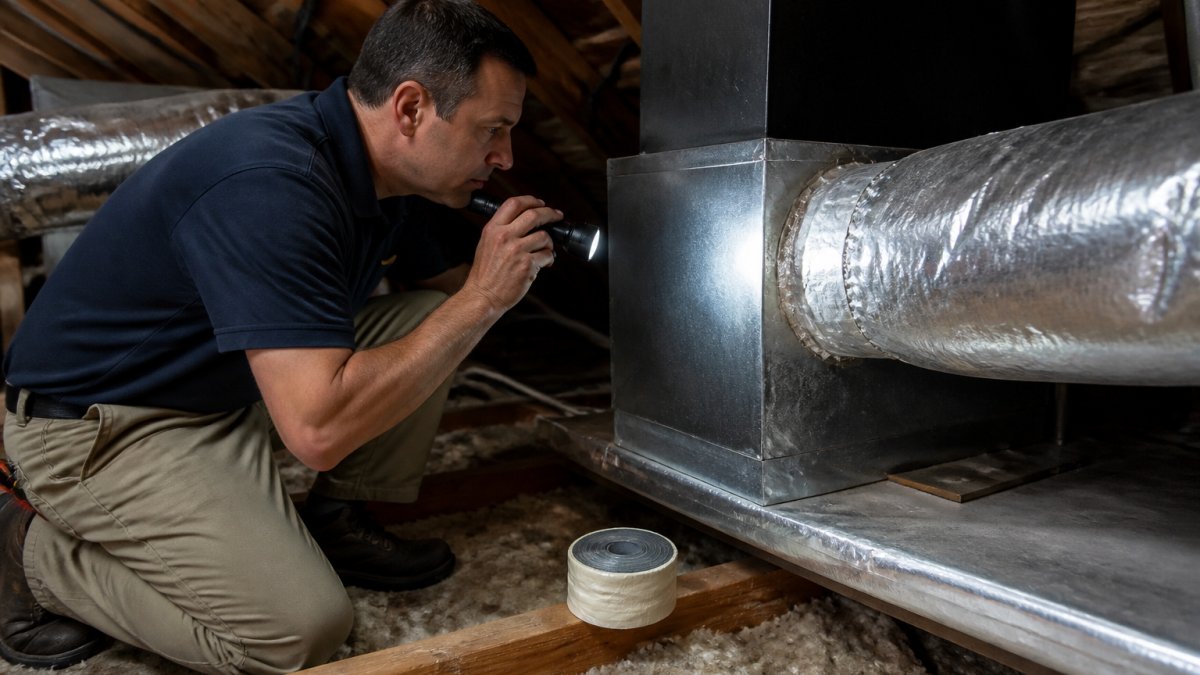
From a safe, accessible location, look for:
- Separated seams along the plenum and main trunk.
- Gaps where branch ducts meet the trunk.
- Loose or missing sealing material at connections.
Old cloth-backed duct tape can dry out and peel away. Insulation may hide gaps underneath, so a visual check will not catch every leak.
DIY Inspection Limits and When to Call a Technician
Limit homeowner checks to registers and exposed ducts you can reach safely. Do not climb through an attic, enter a tight crawlspace, cut into ductwork, or remove equipment panels to look for leaks.
Use these boundaries:
| Task | Safe for DIY? | Why |
|---|---|---|
| Tissue airflow comparison | Yes, at safely reachable registers | No equipment disassembly is needed. |
| Visual check of exposed ducts | Yes, from safe footing | Look without climbing or disturbing ductwork. |
| Sealing accessible seams with mastic | Sometimes | The joint must be secure, safely reachable, and suitable for the product. |
| Attic or crawlspace inspection | Leave it to a professional | Heat, falls, wiring, and poor air quality can create hazards. |
| Duct leakage testing | No | It requires specialized equipment and interpretation. |
| Reconnecting a separated duct | No | The connection needs proper fastening, sealing, insulation, and support. |
For a suitable, accessible joint, use mastic or tape specifically rated for that duct application and follow the product instructions. General-purpose cloth tape is not a lasting duct seal. If the duct is loose, damaged, or difficult to reach, leave the repair to a technician.
Schedule a Duct Leak Inspection With Ricotta Heating & Air
Ricotta Heating & Air is a family-owned company based in Hillsboro, serving Jefferson County and South St. Louis County. If your vents keep blowing warm, contact us to request an inspection.
Tell us which rooms are affected, whether airflow has changed, and what you have already checked. Those details help guide the diagnosis of duct leaks, cooling faults, and airflow restrictions.
If uneven comfort continues during heating season, visit our heating and furnace services page to request help with that concern.
Start with an inspection rather than guessing which part needs repair.
Frequently Asked Questions
Can duct leaks cause warm air to come from vents?
Yes, duct leaks can contribute to poor cooling. Supply leaks let cooled air escape, and return leaks can pull hot air into the system. Heat gain through poorly insulated ducts can also warm the air before it reaches a room. A supply leak may simply reduce airflow, so warm vent air alone does not confirm leakage.
How do I test airflow from an air vent at home?
Hold a tissue near each supply register while the AC is cooling. Keep hold of it and compare its movement from room to room. This is a rough comparison, not an airflow measurement. Note weak registers and warm rooms, then share those observations with your technician.
What are the most common signs of leaking air ducts?
Possible signs include uneven temperatures, weak airflow, hissing near joints, dust around registers, and increased energy use without an obvious change in habits or weather. A disconnected branch may leave one room with very little airflow. These symptoms can have other causes, so a technician may need to inspect the ducts and test for leakage.
When should I call an HVAC technician about a duct leak?
Call if a room stays warm after you check the filter, open the registers, and confirm the thermostat settings. Also request service if airflow suddenly drops, you can safely see a separated duct, or the problem keeps getting worse. Ricotta Heating & Air can help evaluate whether the trouble involves ductwork, airflow, or the cooling equipment.

This article was written with AI assistance and edited for Hillsboro and Jefferson County homeowners by Ricotta Heating & Air. For advice about your own system, call (314) 333-5900.