
HVAC Diagnostic Fee: What Homeowners Should Expect
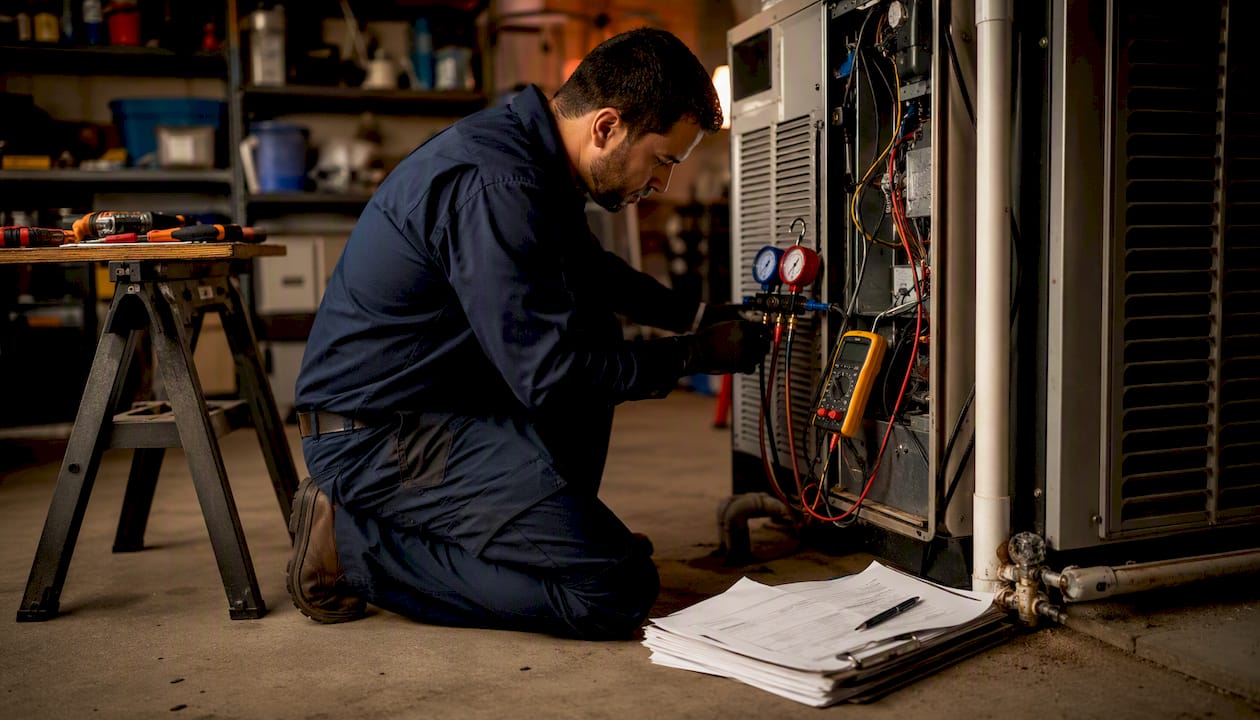
Most homeowners pay an HVAC diagnostic fee within a typical national range for a standard daytime residential visit. After-hours, weekend, or emergency calls generally cost more, reflecting a common 1.5×–2× multiplier that most contractors apply outside normal business hours. The good news: many reputable shops credit or waive the diagnostic fee when you approve repair work during the same visit. That policy is not universal, though, so always confirm it before the technician leaves the driveway.
Here is the short version of what to expect:
- Daytime residential diagnostic commonly falls within a broad national range, with many calls landing in a moderate fee band
- After-hours or emergency diagnostic usually costs more, depending on the contractor and time of call
- Credit-on-hire: Common but not guaranteed — ask before booking
- Visit length: 30–90 minutes for most residential systems
The U.S. Bureau of Labor Statistics tracks HVAC technician wages, and those labor costs feed directly into what contractors charge for a service call. The Department of Energy notes that system complexity, including heat pumps and multi-zone setups, adds meaningful diagnostic time. Ricottaheatingandair, serving Jefferson County and St. Louis, bundles travel and diagnosis into a single service-call number and credits that fee toward repairs when you approve the work on the same visit.
Table of Contents
- What does an HVAC diagnostic fee typically cost?
- What does a technician actually do during a diagnostic visit?
- How do contractors structure diagnostic fees and credit policies?
- What factors push your diagnostic fee higher or lower?
- Diagnostic fee vs. trip charge vs. hourly rate: what’s the difference?
- How long does a diagnostic visit take?
- How to avoid overpaying: questions to ask before you book
- How Ricottaheatingandair handles diagnostics in Jefferson County
- Key Takeaways
- The diagnostic fee conversation most homeowners skip
- Ricottaheatingandair: schedule your diagnostic in Jefferson County
- Useful sources
What does an HVAC diagnostic fee typically cost?
National cost data shows a wide range for the standard daytime residential service-call fee, with a common cluster in moderate fee levels. Costs vary by region, time, and system complexity, with after-hours and emergency calls generally priced higher, typically in the $150–$300 range.

A simple thermostat issue might take a shorter time and be relatively less costly. More complex diagnostics, such as for heat pumps, take longer and cost more, especially with added access difficulties. Contractor pricing guidance generally supports a broad range for residential daytime service calls and elevated after-hours fees.
What does a technician actually do during a diagnostic visit?
You are paying for skilled, instrumented troubleshooting, not just a visual once-over. A professional HVAC diagnostic typically takes 30–90 minutes on-site and covers a structured sequence of checks:
- Visual system inspection: Condition of the air handler, condenser, ductwork connections, and refrigerant lines
- Electrical checks: Voltage and amperage readings at the disconnect, capacitors, contactors, and control board
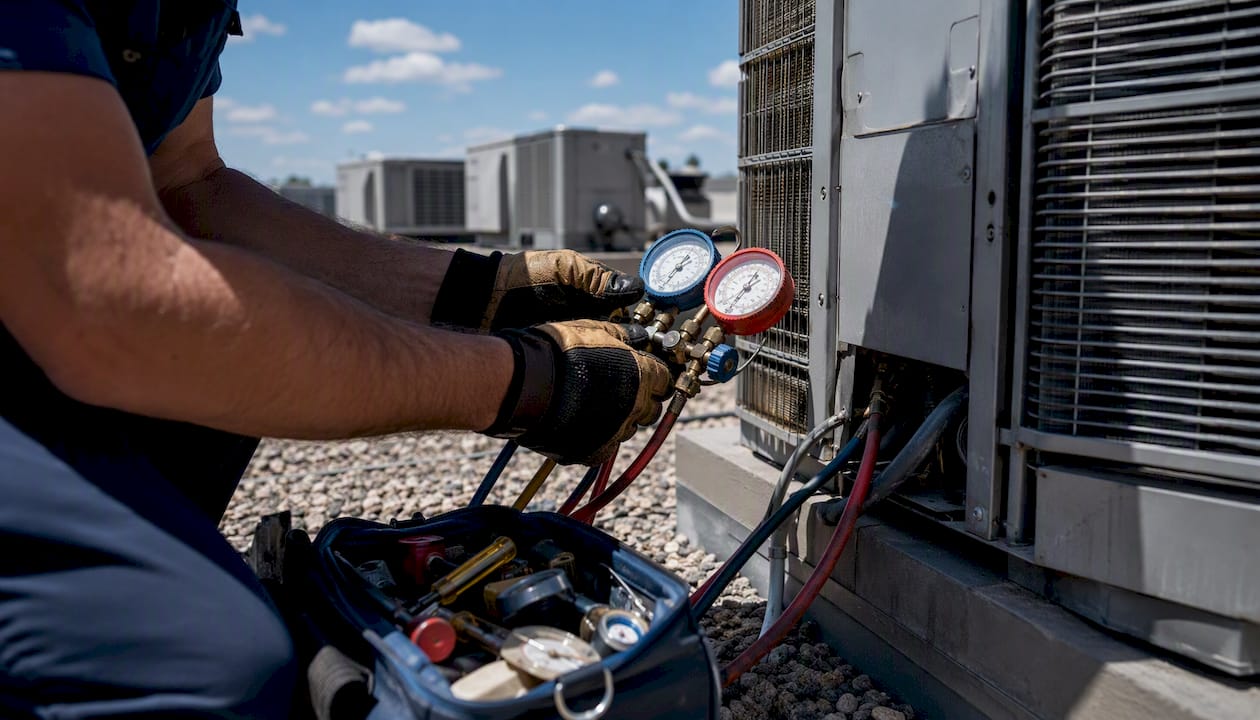
- Refrigerant pressure measurement: Manifold gauge readings to assess charge level and identify leaks
- Combustion analysis (furnaces): A combustion analyzer measures CO output, flue temperature, and heat exchanger integrity
- Controls and thermostat tracing: Verifying signal flow from the thermostat through the control board to each component
- Load test: Running the system under normal operating conditions to catch intermittent faults that don’t show at rest
The tools involved, digital refrigerant gauges, combustion analyzers, and multimeters, represent a real capital investment. Shops amortize that equipment cost into diagnostic pricing, which is part of why a $100 service call is not just paying for someone to look at your unit.
Pro Tip: Ask the technician whether the diagnostic includes a written estimate for parts and labor, and confirm before they start whether the service-call fee applies toward the repair if you approve the work that day.
How do contractors structure diagnostic fees and credit policies?
Most contractors use one of two billing structures. The first bundles the truck roll and baseline troubleshooting into a single flat service-call fee, which is the cleaner approach for homeowners. The second lists a separate trip charge and a diagnostic line item, which can look like double-billing even when it is not.
A well-configured diagnostic fee that is credited toward the repair removes the biggest customer objection and protects shop margins at the same time. Contractor pricing guides consistently recommend this credit-on-hire model as the standard for reputable shops in 2026.
The credit-on-hire policy works like this: the technician diagnoses the problem, presents a repair estimate, and if you approve the work during the same visit, the service-call fee is applied as a credit on the final invoice. You pay for parts and labor, not the diagnostic on top of it.
Smaller independent shops sometimes treat the diagnostic as non-refundable regardless of whether you approve repairs. That is not inherently unfair, since the technician’s time and tools have real value, but it is worth knowing before you book. Contractors size the service-call fee to cover truck operating costs and a loaded hour of labor, so the fee reflects genuine overhead whether or not a repair follows.
After-hours and emergency multipliers are standard across the industry. A 1.5× multiplier on a $100 base fee produces a $150 after-hours call; a 2× multiplier on a $120 base produces $240. Most contractors present these as flat after-hours brackets, typically in the $150–$300 range, rather than calculated multipliers, so the invoice will usually show a single after-hours service-call number.
What factors push your diagnostic fee higher or lower?
The $70–$200 national range is wide because several real variables move the number. Here is what actually changes the price:
- Region and local labor rates: Metro areas with higher wages, think Chicago or coastal cities, have higher base fees. St. Louis and Jefferson County sit in a mid-range labor market, which generally keeps fees closer to the national median.
- Time of call: A scheduled weekday appointment is the cheapest option. Evenings, weekends, and holidays trigger the multipliers described above.
- System type and complexity: Heat pumps, packaged rooftop units, and multi-zone systems take longer to diagnose than a standard split system. Older equipment with non-standard wiring adds time too.
- Accessibility: A unit in a finished basement with clear access is straightforward. A rooftop package unit or a system tucked into a tight crawl space adds time and physical risk, both of which factor into the fee.
- Travel distance: Technicians amortize fuel, vehicle maintenance, and stocked parts across every call. Longer drives from the shop to your home show up in the fee, especially in rural parts of Jefferson County.
Pro Tip: Scheduling a diagnostic during normal weekday hours and providing clear access to the equipment, including moving stored items away from the air handler, is the simplest way to keep the fee at the low end of the range.
Diagnostic fee vs. trip charge vs. hourly rate: what’s the difference?
These three terms appear on invoices in ways that confuse even experienced homeowners. Here is how they typically differ:
| Term | What It Covers | When It Applies |
|---|---|---|
| Service-call fee | Truck roll + baseline on-site troubleshooting | Charged at booking or arrival; often credited on repair |
| Trip charge | Truck roll only (travel cost) | Sometimes listed separately from diagnostic labor |
| Diagnostic fee | Skilled troubleshooting labor and equipment use | May be bundled into service-call or listed separately |
| Hourly labor rate | Time-and-materials work after diagnosis | Applies to repairs billed by the hour ($150/hr typical) |
| Flat-rate repair price | Fixed price for a defined repair task | Replaces hourly billing for common, predictable jobs |
Flat-rate pricing works well for common repairs; time-and-materials suits complex or unpredictable troubleshooting. The diagnostic itself is almost always a flat service-call fee, not an hourly charge.
Watch for invoices that list a trip charge, a dispatch fee, and a diagnostic fee as three separate line items for the same basic truck roll. Reputable shops bundle these into a single service-call number for clarity. If you see three overlapping truck-roll fees, ask the contractor to explain each one before approving any work.
How long does a diagnostic visit take?
For most residential systems, plan on 30–90 minutes of on-site time. A straightforward issue, like a tripped breaker or a failed capacitor, often resolves in under 45 minutes. Intermittent faults that only appear under specific operating conditions can take longer, and occasionally require a follow-up visit once the system has run for a few days.
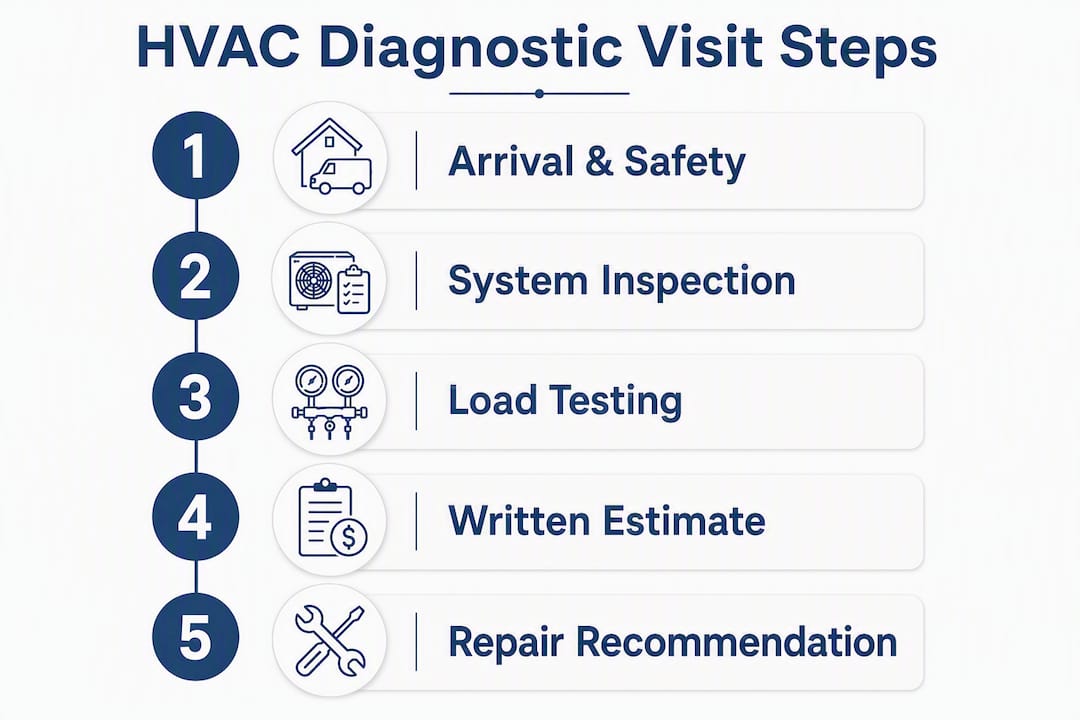
The visit typically flows like this:
Arrival and safety check → the technician confirms power status, checks for gas odors or visible hazards, and reviews your description of the symptoms.
System inspection and measurements → visual checks, electrical readings, and refrigerant pressure or combustion data are recorded.
Load test → the system runs under normal conditions while the technician monitors performance data.
Written estimate and recommendation → the technician presents findings, explains the repair options, and gives you a written cost estimate before any work begins.
To help the process go smoothly, have your system’s model and serial number handy, note when the problem started and whether it is constant or intermittent, and make sure the technician has clear access to the air handler, outdoor unit, and electrical panel.
How to avoid overpaying: questions to ask before you book
A short phone conversation before dispatch eliminates most billing surprises. Here is a numbered checklist you can work through when calling any HVAC contractor:
- “What is your total service-call fee for a daytime residential visit?” Get a single number, not a range.
- “Is that fee credited toward the repair if I approve the work today?” Confirm the credit-on-hire policy explicitly.
- “What is your after-hours or emergency rate?” Ask for the flat fee or multiplier so you know before a late-night call.
- “Do you charge a separate trip charge on top of the diagnostic fee?” This catches double-billing before it appears on the invoice.
- “What is your hourly labor rate, or do you use flat-rate pricing for repairs?” Knowing this helps you evaluate the repair estimate.
- “Will I receive a written estimate before any repair work begins?” A reputable contractor will always say yes.
- “Are your technicians EPA Section 608 certified for refrigerant work?” Required by federal law for any refrigerant handling.
Red flags to watch for: vague answers about total fees, refusal to provide a written estimate, or an invoice with three separate truck-roll line items. A contractor who cannot clearly explain their pricing structure before arriving is unlikely to be clearer once the work is done.
Maintenance plans and service agreements are worth asking about too. Many contractors reduce or waive the diagnostic fee for members on annual maintenance contracts, which can make the plan pay for itself after a single service call.
How Ricottaheatingandair handles diagnostics in Jefferson County
Ricottaheatingandair uses a single bundled service-call fee that covers the truck roll and on-site diagnosis, with no separate trip charge or dispatch fee stacked on top. When you approve a repair during the same visit, that fee is credited toward your invoice. For emergency furnace repair or after-hours AC calls, an after-hours rate applies and is quoted clearly when you call, before anyone is dispatched.
The team brings over 50 years of combined local experience in Jefferson County and the St. Louis area, and more than 150 five-star Google reviews reflect a consistent pattern of honest, pressure-free recommendations. The diagnostic process always ends with a written estimate before any repair work begins. If the diagnosis points toward a system replacement rather than a repair, that conversation is handled separately, at no additional charge, because a replacement walkthrough is a different kind of visit.
Pro Tip: When you book with Ricottaheatingandair, ask for written confirmation of the quoted service-call fee in your booking text or email. That way, the number on your invoice matches what you were told, every time.
Key Takeaways
Most homeowners who ask the right questions before dispatch pay a fair HVAC diagnostic fee and face no billing surprises when the technician arrives.
| Point | Details |
|---|---|
| National cost range | Expect $70–$200 for a daytime residential diagnostic; after-hours calls typically run $150–$300. |
| Credit-on-hire policy | Many contractors apply the diagnostic fee toward the repair — always confirm this before booking. |
| What the fee covers | Skilled labor, calibrated equipment, and a written estimate; not just a visual inspection. |
| Avoid double-billing | Reputable shops bundle trip and diagnostic charges into one service-call number. |
| Ricottaheatingandair | Serves Jefferson County and St. Louis with a single bundled service-call fee, credit-on-hire, and written estimates before any repair begins. |
The diagnostic fee conversation most homeowners skip
There is a pattern worth naming. Homeowners who feel burned by HVAC bills almost always skipped one phone call: the upfront conversation about fee structure. They assumed the diagnostic was free, or that the trip charge and diagnostic were the same thing, or that approval of repairs automatically zeroed out the service-call fee. None of those assumptions are safe.
The diagnostic fee is not a profit grab. It covers a technician’s time, a truck stocked with thousands of dollars in calibrated tools, and the expertise to find the actual problem rather than swap parts until something works. A methodical, instrumented diagnosis prevents the “shotgun” approach, where a shop replaces components one by one until the system runs, billing you for each attempt. That kind of guesswork costs far more than a $100 service call.
What I find most telling is that the contractors with the clearest fee policies, the ones who quote a single number, explain the credit-on-hire policy without being asked, and hand you a written estimate before touching anything, are almost always the ones with the strongest local reputations. Transparency and competence tend to travel together. If a contractor gets evasive when you ask about their service-call fee, that tells you something important before the truck ever leaves the shop.
Ask for EPA Section 608 certification if refrigerant work is involved. Ask for a written estimate. And ask whether the diagnostic fee is credited on approval. Those three questions cover most of the risk.
Ricottaheatingandair: schedule your diagnostic in Jefferson County
Honest pricing and no surprise line items are the baseline at Ricottaheatingandair, not a selling point. Homeowners across Jefferson County and the St. Louis area get a single bundled service-call fee, a written estimate before any repair begins, and a credit-on-hire policy that applies the diagnostic toward your repair invoice when you approve the work the same day.

If you are on a maintenance plan, diagnostic fees can be reduced or waived entirely, making the annual agreement pay for itself quickly. For homeowners in Mehlville, Cedar Hill, Hillsboro, and the surrounding communities, scheduling is straightforward: call, get a quoted service-call fee before dispatch, and know exactly what to expect when the technician arrives.
Book your diagnostic visit today and get a written estimate before any repair work begins.
Useful sources
The figures and policies in this article draw from national contractor pricing guidance and federal labor data. When comparing quotes in your area, use these ranges as a benchmark, not a guarantee, since local labor markets and individual shop policies vary.
- Bureau of Labor Statistics — HVAC Mechanics and Installers: National wage data that underpins labor cost benchmarks for service calls.
- U.S. Department of Energy — Air Conditioner Maintenance: Guidance on system complexity and maintenance requirements.
- U.S. Department of Energy — Heat Pump Operation and Maintenance: Context on heat pump diagnostic complexity.
- EPA Section 608 — Refrigerant Handling Certification: Federal certification requirement for any technician handling refrigerants.
- AC Diagnostic Cost Guide — Current Cost: Residential AC diagnostic cost ranges by scenario.
A note on local quotes: National ranges give you a useful starting point, but always get at least two written quotes from licensed local contractors before approving any diagnostic or repair work. Prices in high-cost metros and rural areas can sit at opposite ends of the national band.