
Furnace Lifespan: What to Expect and When to Replace
Most residential furnaces last 15 to 20 years with proper care, and some well-maintained units stretch to 25 or even 30. Field data puts the median replacement age around 17.7 years, so if your furnace has crossed the 15-year mark, start budgeting now. If you’re hearing strange noises or smelling something off, don’t wait for a number on a calendar. Call for an inspection today.
TL;DR:
- Most furnaces start needing replacement around 17.7 years, with a quarter failing before 13 years, often due to poor installation or neglect.
- Operating a furnace beyond 15 years warrants attention, especially if it shows signs like uneven heating, increased energy bills, or strange noises.
- Proper installation, routine maintenance, and avoiding overuse through programming can extend a furnace’s lifespan to over 20 years.
- Repair costs exceeding 50% of a new furnace’s price or three or more repairs in two seasons typically favor replacement.
- Replacing both furnace and AC simultaneously is advisable if both are aging to prevent efficiency issues and maximize warranty coverage.
Table of Contents
- How Long Do Furnaces Actually Last?
- What Factors Determine How Long a Furnace Lasts?
- What Are the Warning Signs a Furnace Needs Replacing?
- How Can You Extend Your Furnace’s Life?
- Should You Repair or Replace an Aging Furnace?
- Should You Replace Your Furnace and AC Together?
- Why Trust This Furnace Lifespan Guide?
- What Should You Actually Do With This Information?
- Ready to Plan Your Next Heating Move?
- Sources
How Long Do Furnaces Actually Last?
The honest answer depends on which numbers you’re looking at, so let’s walk through them.
Field data on real furnace replacements shows a median age of 17.7 years, with the 25th percentile landing at 12.8 years and the 75th percentile stretching to 22.3 years. In plain terms: a quarter of furnaces get replaced before their 13th birthday (often due to poor installation, harsh runtime, or a lemon unit), while a quarter make it past 22 years. You’re not looking at a fixed expiration date. You’re looking at a range shaped by how well the unit was installed, sized, and maintained.
Furnace lifespan by type:
- Standard-efficiency gas furnaces typically run around 15 to 20 years, occasionally lasting longer with excellent care and light usage. The most common failure point is the heat exchanger, which cracks under repeated heating and cooling stress over time.
- High-efficiency condensing gas furnaces (90%+ AFUE) fall in a similar 15 to 20 year window, but their added electronics and secondary heat exchangers give them a different failure profile. When they fail early, it’s often a control board or condensate system issue rather than a cracked primary exchanger.
- Electric furnaces often outlast gas units, commonly reaching 20 to 30 years since they skip combustion entirely. Heating elements and blower motors are the parts that eventually give out.
- Oil furnaces tend to land in the same 15 to 20 year territory as gas units, though fuel quality and tank maintenance play a bigger role in how long they hold up.
Industry life-expectancy tables used by ASHRAE and DOE modeling typically set the standard useful life for a gas furnace at around two decades. That figure isn’t a guess. It’s baked into lifecycle cost analyses that utilities and manufacturers use to plan efficiency programs, which tells you the 15 to 20 year window isn’t marketing spin. It’s the actual planning assumption behind the whole industry.
Manufacturer warranties (often 10 years on parts, sometimes 20 on the heat exchanger) hint at this same math. A warranty period is a company’s calculated guess at when failures cluster, not a promise the unit dies the day after it expires. But it’s a useful signpost: once you’re past your warranty window, you’re operating in bonus time, and that’s exactly when a maintenance-first mindset starts paying off.
What Factors Determine How Long a Furnace Lasts?
Two furnaces installed the same year in the same neighborhood can age at wildly different rates. Here’s what actually drives that gap.
- Correct installation and sizing. An oversized furnace short cycles, firing up and shutting off repeatedly instead of running a steady, efficient cycle. That constant start-stop pattern wears down igniters, blower motors, and heat exchangers years before their time. A proper Manual J load calculation at install matches the unit to your home’s actual heat loss, not a contractor’s rough guess.
- Routine maintenance. An annual professional tune-up and a regular filter change every 30 to 90 days are the two highest-leverage things you control. Skip them and you’re asking a system designed for two decades of service to survive on neglect.
- Climate and runtime. A furnace in a region with a long, harsh winter logs far more operating hours per year than one in a mild climate, and more hours means faster wear regardless of how well you maintain it.
- Equipment quality and placement. A furnace crammed into a damp, dusty crawlspace or a corrosive environment (think laundry rooms with bleach fumes) ages faster than one in a clean, dry mechanical closet.
- Usage patterns. Constant thermostat swings force the system to work harder than steady, moderate settings do.
Pro Tip: A clogged filter doesn’t just choke airflow, it makes your blower motor work like it’s breathing through a pillow. That extra strain adds up fast, and it’s the single easiest failure point to prevent for the cost of a $15 filter.
What Are the Warning Signs a Furnace Needs Replacing?
Age is your first clue, but it’s not the only one. Once a furnace passes 15 years, treat every winter as a bonus round and start watching for these signals.
- Uneven heating, where some rooms stay chilly no matter how high you crank the thermostat, often points to a failing blower or ductwork the system can no longer push air through efficiently.
- Climbing energy bills with no change in usage habits usually means declining combustion efficiency, a sign the unit is burning more fuel to produce the same heat.
- Frequent breakdowns, especially more than two or three in a single heating season, is the practical trigger point we’ll cover in the repair-versus-replace section below.
- Strange smells or noises (banging, screeching, or a persistent burning odor) deserve an immediate call, not a wait-and-see approach.
- A cracked heat exchanger is the one finding that should end the repair conversation entirely. It’s a safety issue tied to potential carbon monoxide leaks, and it’s a hard replace signal every time.
If your unit is showing two or more of these signs regardless of its age, schedule an emergency inspection rather than gambling on one more season.
Two quick housekeeping steps make this whole process easier. First, find your furnace’s manufacture date from the serial number (most manufacturers encode it in the first four digits) so you know exactly how old the unit really is. Second, keep a simple log of every repair, date, and cost. That log becomes your best evidence when it’s time to decide whether one more fix makes sense.
How Can You Extend Your Furnace’s Life?
Getting a furnace to the high end of its range, 20-plus years instead of 15, comes down to a short list of habits done consistently rather than any single trick.
- Book an annual professional tune-up. A qualified technician checks the heat exchanger for cracks, tests the ignition system, measures gas pressure, inspects the blower motor, and verifies safety controls. This single visit catches small problems while they’re still cheap to fix.
- Change your filter every 30 to 90 days. Standard fiberglass filters need monthly swaps; pleated filters can often stretch to 90 days, but check monthly during peak heating season regardless.
- Verify airflow isn’t restricted. Closed vents, blocked returns, and furniture pushed against registers all force your system to work harder than it should.
- Program your thermostat for moderate, steady settings rather than dramatic swings. A smart thermostat that gently ramps temperature down at night reduces the strain of constant full-power cycling.
- Know your limits. Filter changes and clearing vents are fine DIY territory. Anything involving the gas line, electrical components, or the heat exchanger needs a certified technician, no exceptions.
Pro Tip: Think of your furnace’s filter like a face mask. A fresh one lets it breathe easy. A three-month-old, dust-caked one makes every single cycle harder than it needs to be, and that daily strain is what quietly shaves years off the unit’s working life.
Should You Repair or Replace an Aging Furnace?
When a repair estimate lands in your inbox, three simple rules cut through the guesswork better than gut instinct.
- The 50% rule: if the repair cost exceeds 50% of a new furnace’s price, replacement usually makes more financial sense than paying to patch an aging system.
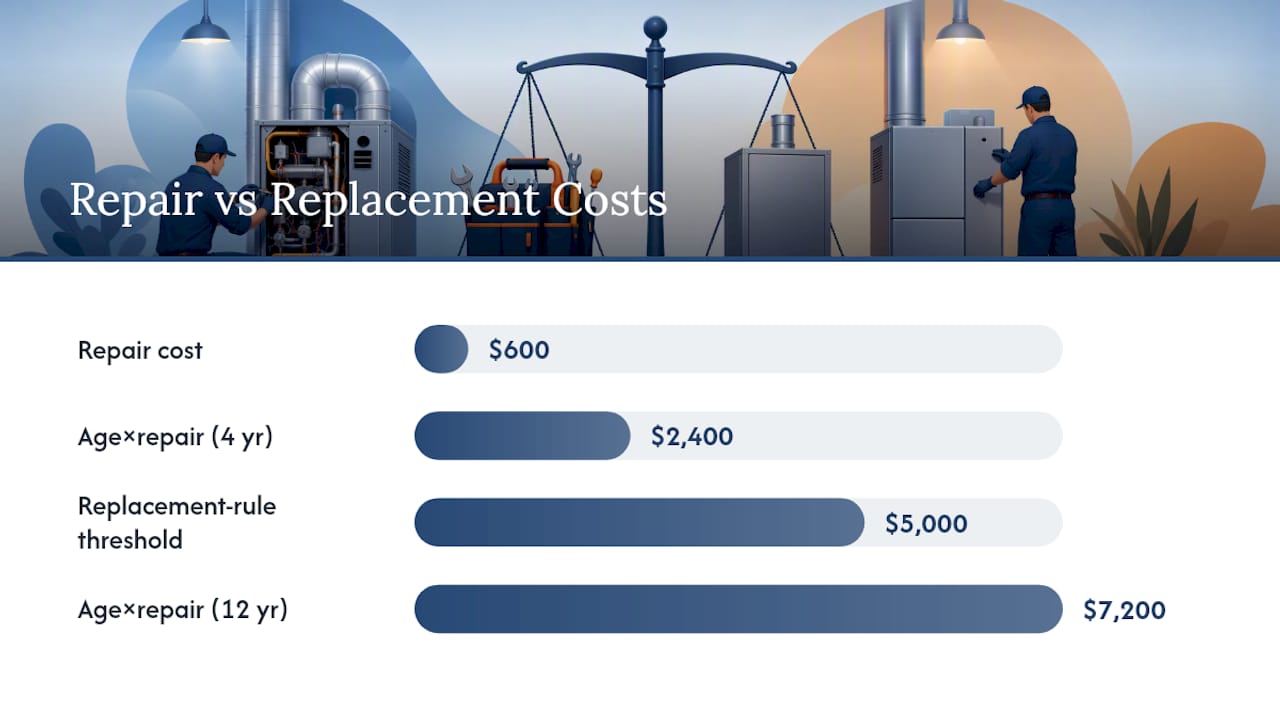
- The $5,000 rule: multiply the furnace’s age by the repair cost. If that number tops $5,000, lean toward replacement. A $600 repair on a 12-year-old unit (7,200) crosses that line; the same repair on a 4-year-old furnace (2,400) doesn’t.
- The 3-repair rule: three or more repairs within two heating seasons signals a system in decline, not a run of bad luck.
Older units compound the math further. Efficiency losses from an aging heat exchanger mean you’re paying more per therm of heat delivered, and replacement parts for units past 15 years grow scarce and expensive as manufacturers phase out older lines.
Timing matters too. Scheduling replacement in the off-season, spring or fall rather than the dead of winter, typically means better equipment availability and lower pricing since contractors aren’t buried under emergency calls.
A quick worksheet helps: add up your furnace’s repair cost plus its expected remaining years of service, then compare that total against a new system’s cost plus the fuel savings a modern, ENERGY STAR-qualified furnace would deliver. If the new-system math wins even by a modest margin, replacing now usually beats nursing an old unit through one more winter.
Should You Replace Your Furnace and AC Together?
If your furnace and cooling system were installed around the same time, replacing them together often makes more sense than replacing one and leaving the other to limp along.
- Mismatched age causes efficiency problems. A brand-new high-efficiency furnace paired with a 15-year-old AC coil rarely performs to its rated specs, and some manufacturers won’t honor full warranty coverage on mismatched systems.
- Cost-benefit favors bundling when both units are aging. If your AC is within a few years of your furnace’s age, staged replacement often costs more in labor and disruption than doing both at once.
- A heat pump conversion or dual-fuel setup is worth exploring if you’re replacing both anyway, particularly if you want lower cooling-season costs alongside reliable gas backup heat during the coldest stretches. Heat pump service options can walk you through whether that swap fits your home.
Why Trust This Furnace Lifespan Guide?
Ricotta Heating & Air has spent 50 years fixing and replacing furnaces across St. Louis and Jefferson County, and the failure patterns above (short cycling from bad sizing, cracked exchangers on 18-year-old units, filters nobody changed in a year) show up on service calls constantly. Our team backs that experience with more than 150 five-star Google reviews from homeowners who called us for honest diagnostics, not upsells.
What Should You Actually Do With This Information?
Start budgeting once your furnace hits year 15, and keep it on an annual maintenance schedule no matter its age. Log every repair. When in doubt, get a real assessment before the next cold snap forces the decision for you.
— Alan
Ready to Plan Your Next Heating Move?
Ricotta Heating & Air gives you something a lot of shops don’t: an honest answer about whether your furnace needs a repair or a replacement, without the pressure to buy more than you need. Our maintenance plans catch the small issues (a worn igniter, a dirty flame sensor) before they turn into a mid-January breakdown, and our technicians service every major brand, so you’re never stuck guessing whether your unit is covered.
If your furnace is already past 15 years or showing any of the warning signs covered above, don’t wait for a failure to force your hand. Schedule a maintenance visit or replacement assessment with our team, and if you’re dealing with a system that’s already down, our emergency furnace repair line is ready for that call today.
Sources
- How Long Does A Furnace Last? | Carrier
- How Long Does a Furnace Last? | Trane
- How Long Do Furnaces Last? (HVAC Base)
- Replace | ENERGY STAR