
Furnace Blowing Cold Air? Causes, Fixes & When to Call
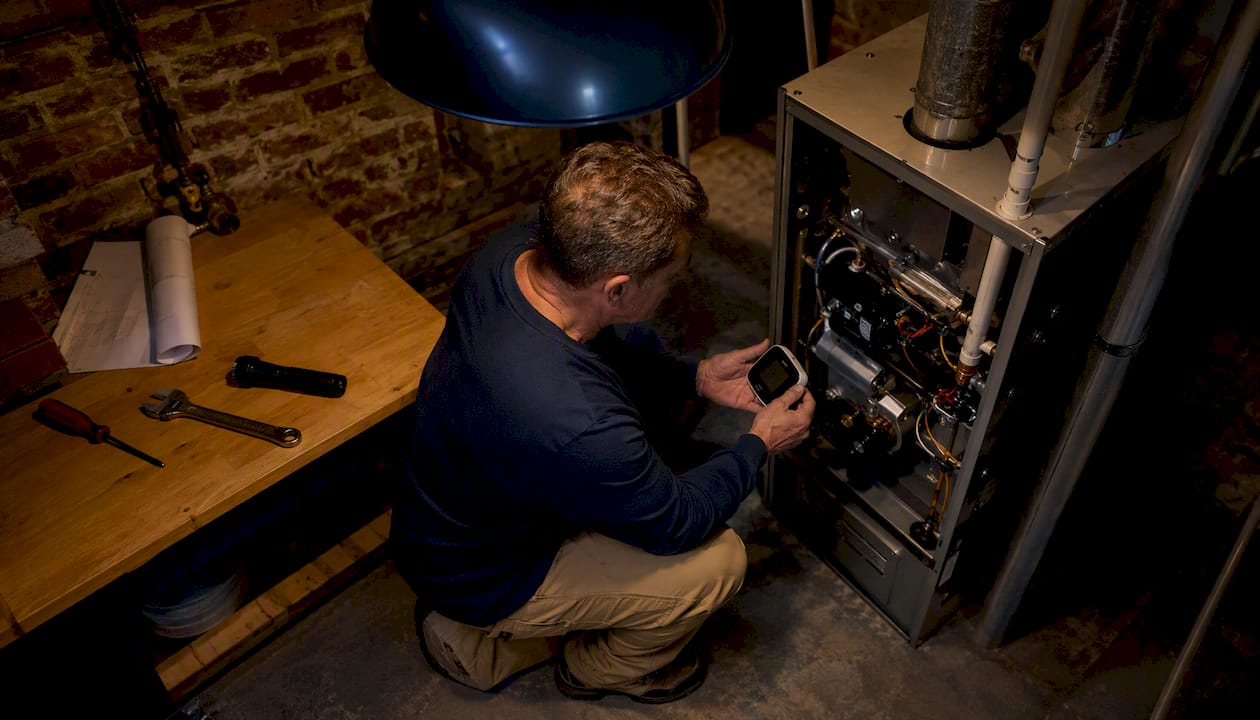
Your furnace is blowing cold air for one of three reasons: the thermostat fan is set to ON instead of AUTO, the air filter is so clogged it tripped the safety shutoff, or there’s an ignition or combustion problem stopping the burners from firing. Before you call anyone, do these checks right now:
- Set the thermostat fan to AUTO (not ON)
- Confirm the mode is set to HEAT, not COOL or OFF
- Raise the setpoint above the current room temperature
- Pull out the air filter and hold it up to a light — if you can’t see through it, replace it
IMPORTANT: If you smell rotten eggs or see soot around the furnace, stop immediately. Shut the system off, open windows, leave the house, and call your gas utility or 911. Do not attempt any further troubleshooting.
If those four checks don’t restore warm air within 15–20 minutes of the furnace restarting, you’re likely dealing with a deeper mechanical issue. The sections below walk you through every cause and what to do about each one.
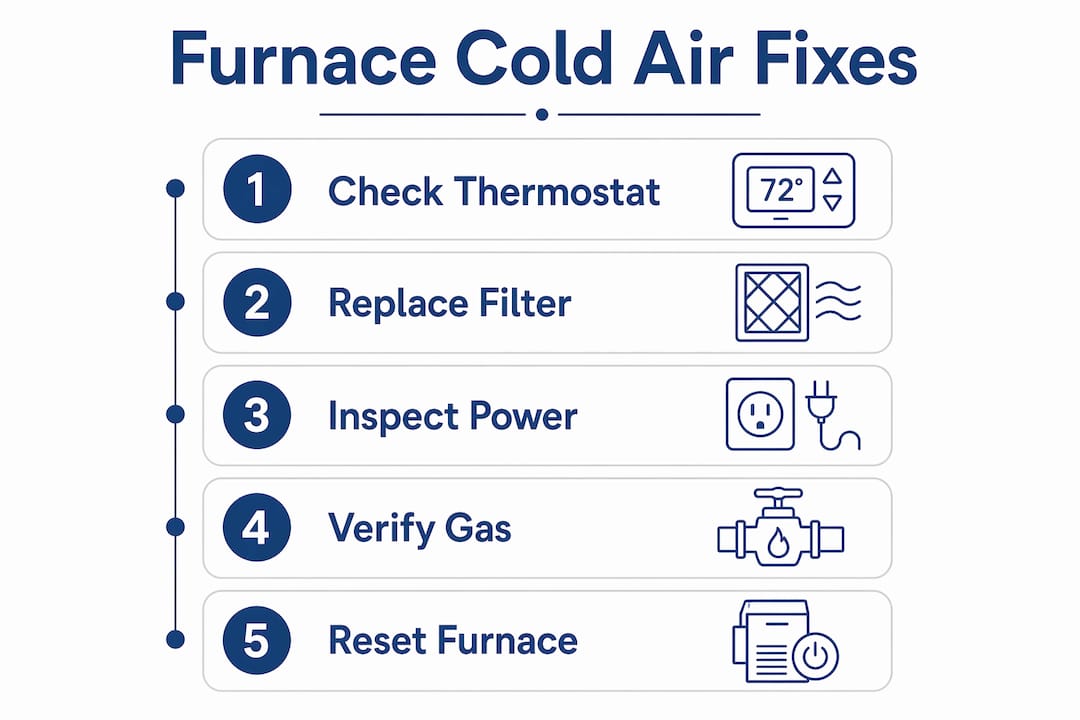
Table of Contents
- Why is your furnace blowing cold air? Common causes mapped to symptoms
- How to troubleshoot a furnace not producing heat: safe DIY checklist
- When to stop DIY and call an HVAC technician
- How to prevent future cold-air episodes
- Expert insight: why homeowners misdiagnose cold air
- Leaky or blocked ductwork is a hidden cause of heat blowing cold
- Flame rollout and the safety switches that protect you
- Key Takeaways
- What I see every winter in St. Louis homes
- Ricottaheatingandair is ready when your furnace isn’t
- Sources and further reading
Why is your furnace blowing cold air? Common causes mapped to symptoms
Understanding what’s happening inside the furnace makes troubleshooting much faster. Here are the most common causes, matched to what you’ll actually observe:
- Thermostat fan set to ON — The blower runs continuously, circulating room-temperature air between heating cycles. It feels cold even though the furnace itself is fine. Switching to AUTO fixes this in under five minutes.
- Thermostat in COOL or OFF mode — The system simply isn’t calling for heat. Check the mode setting first.
- Dirty or clogged air filter — A filter packed with dust blocks airflow, causes the heat exchanger to overheat, and trips the high-limit switch, shutting off the burners while the blower keeps running.
- Tripped high-limit switch — A safety device that cuts the burners when the furnace overheats. Repeated trips almost always point to restricted airflow, not a bad switch.
- Dirty or failed flame sensor — The sensor detects whether a flame is present. When it’s coated in residue, it shuts the gas valve after a few seconds of ignition, leaving the blower pushing unheated air.
- Pilot light or igniter failure — Older furnaces use a standing pilot; newer ones use a hot-surface igniter. Either can fail and prevent the burners from lighting at all.
- Blocked or closed supply registers / return vents — Furniture, rugs, or closed dampers starve the system of airflow and can trigger the same overheat shutdown as a dirty filter.
- Ductwork leaks — Warm air escapes into unconditioned spaces before reaching your rooms. You feel cold air at the vents even though the furnace is producing heat.
- Condensate drain blockage (high-efficiency furnaces) — A clogged drain or tripped float switch shuts the system down entirely on 90%+ AFUE condensing units.
- Gas supply issue — A closed shutoff valve, an empty propane tank, or low gas pressure means the burners can’t ignite. Check other gas appliances to confirm supply.
- Failed blower motor or control board — The fan runs but produces no heat, or the system behaves erratically. These require a technician.
- Heat pump defrost cycle — If you have a heat pump, a normal defrost cycle lasts 1–10 minutes and temporarily blows cool air. This is by design, not a failure.
Symptom-to-cause quick map:
- Fan runs constantly, air is cool → Thermostat fan set to ON
- Burners ignite briefly then shut off → Dirty flame sensor or gas pressure issue
- No ignition at all → Failed igniter, pilot out, or gas supply problem
- Short burst of cool air at startup only → Normal blower delay (30–60 seconds while the heat exchanger warms)
- Heat pump blows cool air for under 10 minutes → Normal defrost cycle
- Heat pump blows cool air persistently → Stuck reversing valve or failed backup heat strips
Pro Tip: Before concluding something is broken, observe a full heating cycle of 15–20 minutes. Many homeowners call for service during what turns out to be a normal startup delay or a routine heat-pump defrost.
How to troubleshoot a furnace not producing heat: safe DIY checklist
Work through these steps in order. Total time for the full checklist: roughly 20–30 minutes.
Step 1: Thermostat check (3–5 minutes)
- Confirm mode = HEAT
- Set fan = AUTO
- Raise setpoint a few degrees above room temperature
- Replace thermostat batteries if the display is dim or blank — a blank thermostat screen is often just dead batteries
- Wait two minutes for the system to respond
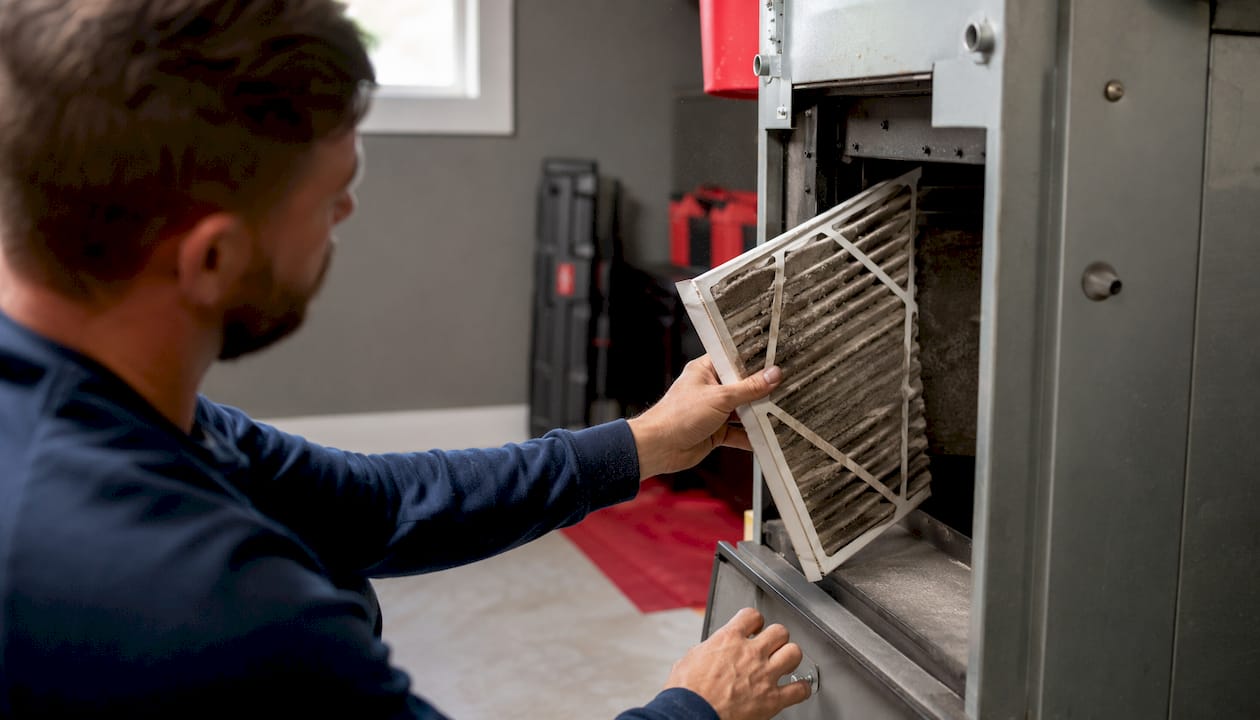
Step 2: Air filter inspection and replacement (5–10 minutes)
- Locate the filter — usually in the return air grille or inside the furnace cabinet
- Slide it out and hold it to a light source
- If it’s gray, matted, or you can’t see light through it, replace it immediately
- Standard 1" filters should be replaced regularly; more often if you have pets or run the system heavily
- Slide the new filter in with the airflow arrow pointing toward the furnace
Think of a clogged filter like trying to breathe through a pillow. The furnace strains, overheats, and the safety switch cuts the burners. A fresh filter often resolves the call on its own.
Pro Tip: Write the installation date on the filter frame with a marker. It takes five seconds and removes all guesswork next time.
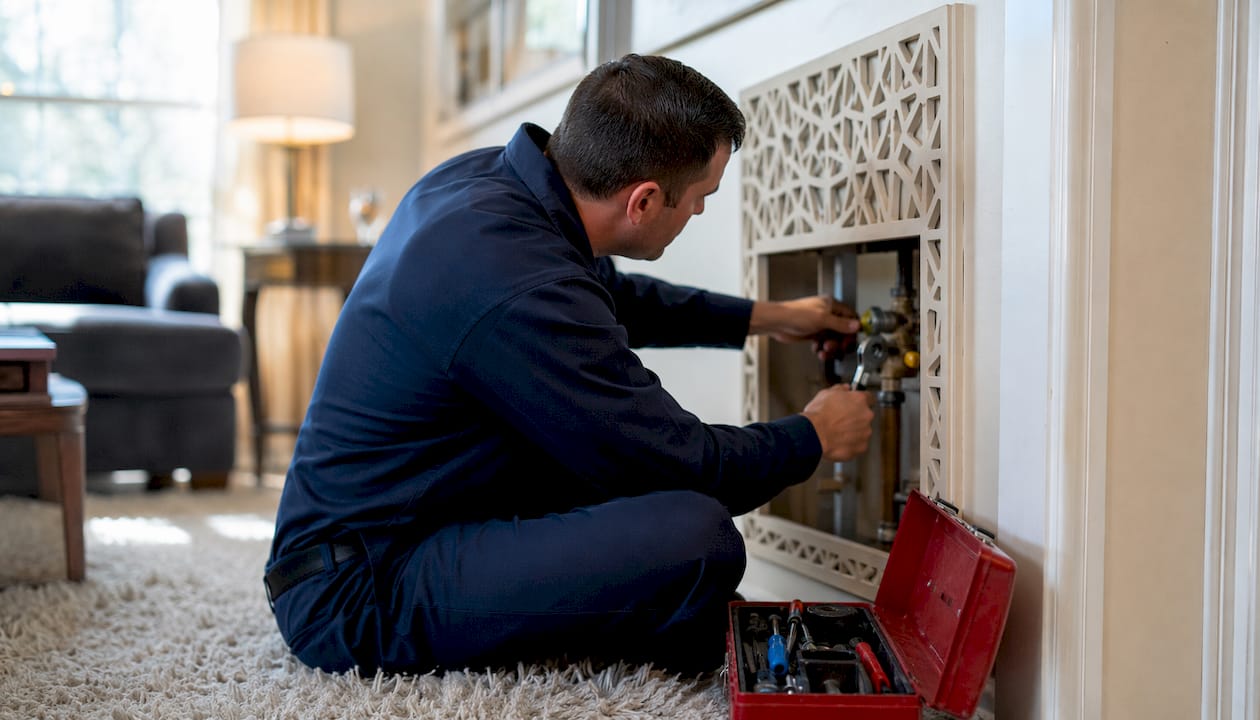
Step 3: Power and gas supply checks (5 minutes)
- Locate the furnace service switch (it looks like a standard light switch, usually on the wall near the unit or on the furnace itself) — confirm it’s in the ON position
- Check the furnace circuit breaker in your electrical panel — reset it once if tripped
- Locate the gas shutoff valve on the supply line leading to the furnace — the handle should be parallel to the pipe (open position)
- Turn on a gas stove burner or check another gas appliance to confirm gas is flowing to the house
IMPORTANT: If you smell gas at any point during these checks, stop. Leave the house, leave the door open, and call your gas utility’s emergency line from outside.
Step 4: Observe the startup sequence (10–15 minutes)
With the thermostat calling for heat, stand near the furnace and listen:
- You should hear the inducer fan spin up first (a low hum)
- Then a click as the igniter glows or the pilot lights
- Then the burners fire (a soft whomp)
- Then the blower kicks on 30–60 seconds later, once the heat exchanger warms
If you hear the inducer and igniter but no burner ignition, the flame sensor or gas valve is the likely culprit. If nothing happens at all after the thermostat call, the control board or a safety lockout may be involved.
Step 5: Safe furnace reset (5 minutes)
- Turn the thermostat to OFF
- Find the furnace power switch or circuit breaker and turn it off
- Wait 30 seconds
- Turn power back on
- Set the thermostat back to HEAT and raise the setpoint
- Observe one full cycle (15–20 minutes) before drawing conclusions
Pro Tip: Most furnaces allow a limited number of ignition attempts before locking out before locking out. If the furnace locks out again after a reset, don’t keep resetting it — that’s the system telling you it needs a technician.
Clear stop points — do not proceed past these without a pro:
- You smell gas or combustion odors
- You see soot, scorch marks, or flame rollout around the burner compartment
- The CO detector has alarmed
- The furnace locks out more than twice after resetting
- You’d need to open the burner compartment to continue
When to stop DIY and call an HVAC technician
Some symptoms are safety issues, not troubleshooting puzzles. Call a technician immediately if you notice any of the following:
- Gas smell (rotten egg odor) anywhere near the furnace or in the home
- Visible soot, burn marks, or discoloration around the furnace cabinet
- Flame rollout (flames escaping outside the burner compartment)
- Carbon monoxide alarm activation
- Electrical burning smell from the furnace
- Repeated short-cycling (furnace turns on and off every few minutes)
- Suspected cracked heat exchanger (CO symptoms: headaches, dizziness, nausea)
What a technician will check on arrival
A qualified HVAC tech will verify the startup sequence, test the flame sensor and igniter, inspect combustion, check the gas valve and supply pressure, test the blower motor and control board, inspect ductwork for leaks, and on high-efficiency units, check the condensate drain and float switch.
Typical repair cost ranges
| Repair | Typical National Range | Estimated Time |
|---|---|---|
| Flame sensor cleaning/replacement | $80–$280 | 1 hour |
| Hot-surface igniter replacement | $150–$420 | 1–2 hours |
| Control board replacement | $450–$700 | 2–3 hours |
| Blower motor replacement | Varies by motor type | 2–4 hours |
| Condensate drain service | — | 1 hour |
| Duct sealing (accessible areas) | Varies by scope | Half to full day |
Pro Tip: Ask your technician upfront whether the diagnostic fee applies toward the repair cost. Many HVAC companies, including Ricottaheatingandair, will credit it — but it’s worth confirming before the visit.
When you call Ricottaheatingandair for emergency furnace repair, have the following ready: your thermostat model, any error codes or blinking light patterns on the furnace control board, a rough timeline of when the problem started, and the age of your last filter change. That information cuts diagnostic time significantly.
How to prevent future cold-air episodes
Monthly and seasonal tasks:
- Check the air filter every month; replace it every 60–90 days (monthly with pets or heavy use)
- Keep all supply registers and return grilles open and unobstructed — closing registers to “redirect” heat actually increases system pressure and can cause overheating
- Check thermostat batteries at the start of each heating season
- Test your CO detectors and smoke alarms monthly
Annual tasks (schedule before the heating season):
- Book a fall furnace tune-up that includes flame-sensor cleaning, igniter inspection, burner cleaning, blower service, and limit-switch testing
- Have the technician inspect the condensate drain and float switch if you have a high-efficiency furnace
- Ask for a combustion analysis and heat-exchanger inspection — a cracked exchanger is a CO risk
Ductwork tips:
- Walk through your home and confirm every supply register is open
- Check visible flex duct runs in the attic or crawlspace for disconnections or kinks
- If certain rooms are always cold, consider having a technician assess airflow balance — it’s often a duct issue, not a furnace issue
Pro Tip: Scheduling your annual tune-up in September or October — before the first cold snap — means shorter wait times and no emergency-rate surprises when temperatures drop.
Expert insight: why homeowners misdiagnose cold air
The most common misdiagnosis Ricottaheatingandair technicians encounter is a homeowner convinced their furnace has failed when it’s actually behaving normally. Two situations cause this repeatedly.
First, the startup blower delay. Many furnaces hold the blower off for 30–60 seconds after the burners ignite, letting the heat exchanger reach temperature before pushing air. That brief rush of cool air at startup is a design feature, not a fault.
Second, heat-pump perception. A gas furnace delivers air at 130–140°F. A correctly operating heat pump delivers air at temperatures warm enough to heat your home but cooler than a gas furnace. That’s warm enough to heat your home to 72°F, but because it’s below your body temperature of 98.6°F, it can feel like a cool draft. If your room temperature is rising and the thermostat is satisfied, the system is working.
Why Ricottaheatingandair?
- Family-owned, serving St. Louis and Jefferson County for 50 years
- 150+ five-star Google reviews from local homeowners
- Services all major brands, including Bryant, Lennox, Trane, Carrier, and Rheem
- Available for emergency furnace repairs when you can’t wait for a scheduled appointment
- Honest diagnostics with no upsell pressure
Leaky or blocked ductwork is a hidden cause of heat blowing cold
Ductwork problems are easy to overlook because the furnace itself is working fine. Warm air leaves the heat exchanger, travels through the supply ducts, and then escapes through a gap or disconnected joint into the attic or crawlspace before it ever reaches your room. At the register, you feel cool air. The furnace looks like the problem, but the ducts are.
Closed or blocked registers create a different version of the same issue. When supply registers are shut in unused rooms, system pressure builds. That forces air through gaps and seams it wouldn’t normally reach, and the rooms that are supposed to get heat end up with reduced airflow. Keeping all registers open, even in rooms you don’t use, is one of the simplest ways to protect your system.
Visible signs of duct trouble include rooms that are always colder than others, a hissing sound near duct joints, or noticeably dusty registers. A technician can perform a duct pressure test to quantify leakage and identify where sealing is needed.
Flame rollout and the safety switches that protect you
Flame rollout happens when the burners ignite but the combustion gases can’t exhaust properly through the heat exchanger. The flames spill out of the burner compartment instead of staying contained. It’s a serious safety condition, and your furnace has a dedicated rollout switch designed to shut everything down the moment it detects it.
The rollout switch is a thermal fuse mounted near the burner assembly. Once it trips, it usually requires manual reset — and in some cases, it’s a one-time device that must be replaced. A technician will reset or replace the switch, but more importantly, they’ll find out why rollout occurred in the first place. Common causes include a cracked heat exchanger, a blocked flue or exhaust vent, or a failed inducer motor that isn’t pulling combustion gases through properly.
IMPORTANT: Never bypass a rollout switch or repeatedly reset it without identifying the underlying cause. Flame rollout can ignite nearby materials and produce carbon monoxide. If you see scorch marks around the burner area or the furnace shuts down immediately after lighting, leave the system off and call Ricottaheatingandair or emergency services.
Key Takeaways
The fastest fix for a furnace blowing cold air is checking the thermostat fan setting and replacing the air filter — two steps that resolve a large share of no-heat calls without any tools or a service visit.
| Point | Details |
|---|---|
| Check thermostat first | Set fan to AUTO and mode to HEAT before anything else — this alone fixes many cold-air complaints. |
| Replace the filter | A clogged filter trips the high-limit switch and cuts the burners; replace every 60–90 days. |
| Observe a full cycle | Observe a full heating cycle before concluding the furnace has failed — startup delays are normal. |
| Know the red flags | Gas smell, soot, flame rollout, or CO alarm means stop DIY immediately and call for help. |
| Ricottaheatingandair | For St. Louis and Jefferson County homeowners, Ricottaheatingandair offers emergency furnace repair and annual tune-ups with honest diagnostics and no upsell pressure. |
What I see every winter in St. Louis homes
The calls that come in on the first genuinely cold night of the season follow a predictable pattern. Someone turns the heat on for the first time since March, and the furnace blows cool air. Nine times out of ten, it’s a filter that’s been sitting there since spring, or a thermostat that got bumped to ON during the summer. Those are five-minute fixes, and I’m glad when a homeowner catches them before we even arrive.
What I want every homeowner in Jefferson County to know is this: Ricottaheatingandair is a family operation. We’ve been doing this for 50 years in this area, and we’re not going to sell you a part you don’t need. When you call us, tell us what you’ve already checked, what error codes or blinking lights you see on the furnace panel, and how long the problem has been happening. That information helps us arrive prepared and get your heat back on faster.
For emergency visits, have the furnace accessible and the area around it clear. If the system has locked out, leave it off until we arrive — repeated resets on a locked-out furnace can mask the fault code we need to diagnose the problem correctly.
One final note: if you suspect a combustion issue, smell gas, or your CO detector has gone off, don’t wait for a scheduled appointment. Leave the house and call emergency services first. Your safety comes before any repair.
Ricottaheatingandair is ready when your furnace isn’t
When the thermostat check and filter swap don’t bring the heat back, you need a technician who shows up prepared, diagnoses honestly, and fixes the actual problem. That’s what Ricottaheatingandair has delivered to St. Louis and Jefferson County homeowners for 50 years.
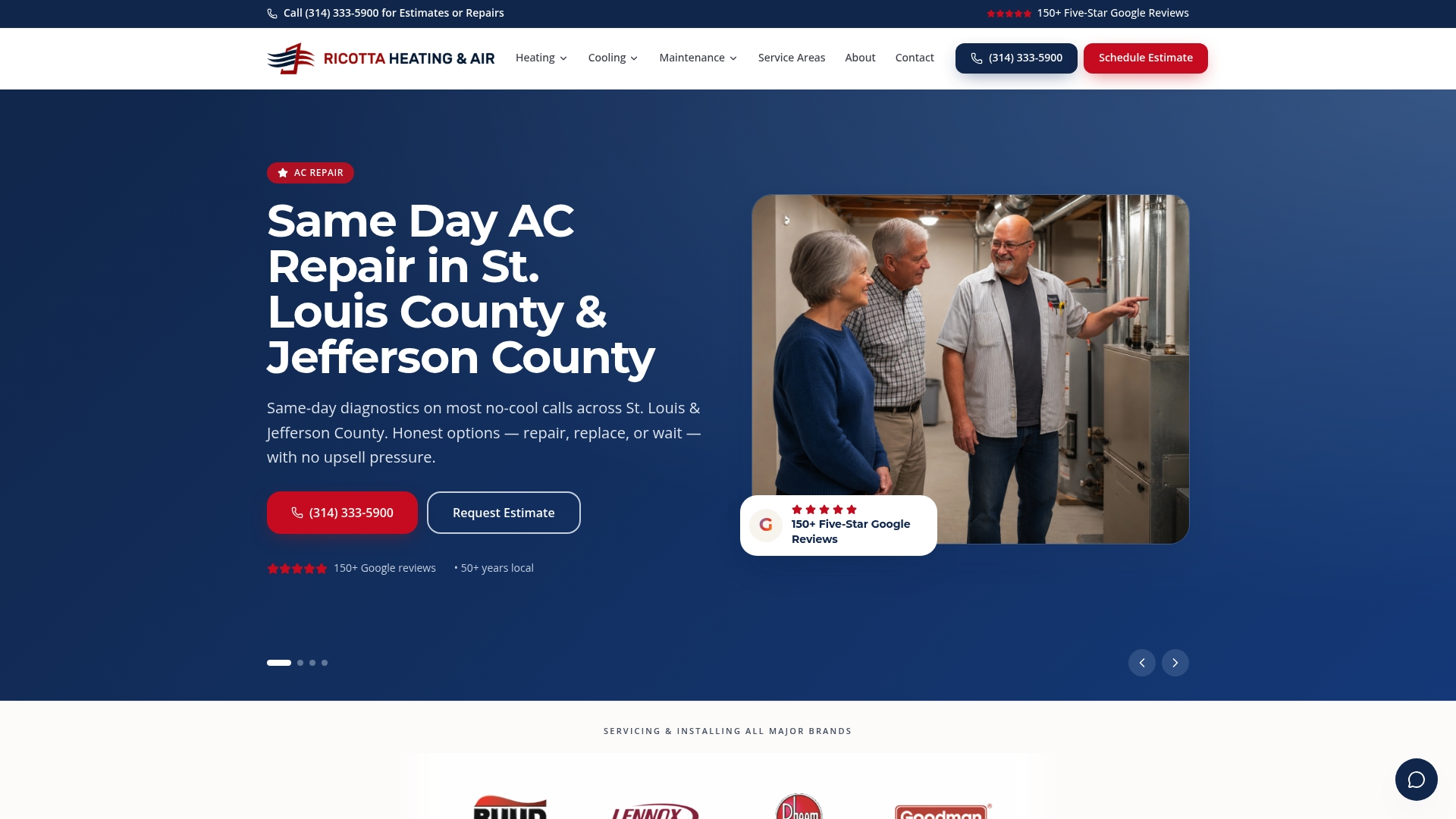
Ricottaheatingandair handles emergency furnace repairs, scheduled diagnostics, flame-sensor and igniter replacements, blower and control-board service, and planned maintenance agreements that keep your system from failing on the coldest night of the year. Before your technician arrives, have your thermostat model, any observed error codes, the approximate age of your last filter change, and a brief description of what the furnace does (or doesn’t do) when it starts up.
Ready to get your heat back? Book a furnace repair with Ricottaheatingandair today — or call us directly for emergency service in St. Louis and Jefferson County.
Sources and further reading
- Why Is My Furnace Blowing Cold Air? | Carrier — Thermostat fan settings and startup blower delay explained
- Furnace Blowing Cold Air? Causes, Fixes & When to Call a Pro | Bryant — Comprehensive cause-and-fix overview from a major manufacturer
- Furnace Blowing Cold Air? 7 Causes & DIY Fixes | Christianson’s — Filter replacement and homeowner checklist guidance
- Gas Furnace Not Blowing Hot Air: Causes and Fixes — Flame sensor, condensate drain, and gas supply detail
- Furnace troubleshooting (limit switch) | Trane — High-limit switch behavior and airflow restriction guidance
- Why is my heat pump blowing cold air? | TOSOTdirect — Defrost cycle timing and reversing valve issues
- Furnace repair cost guide | Modernize — National typical repair cost ranges for common furnace components
- Cold blow from heat-pump supply air | Green Building Advisor — Why heat-pump air feels cool and how long to observe before concluding a fault